


What is HVAC deferred maintenance risk?
HVAC deferred maintenance risk is the compounding threat of system failures, inflated costs, safety hazards, and regulatory penalties that builds every time a necessary maintenance task gets pushed to “later.” It is not simply a backlog problem. Each skipped service creates conditions where the next failure is both more likely and more expensive to fix.
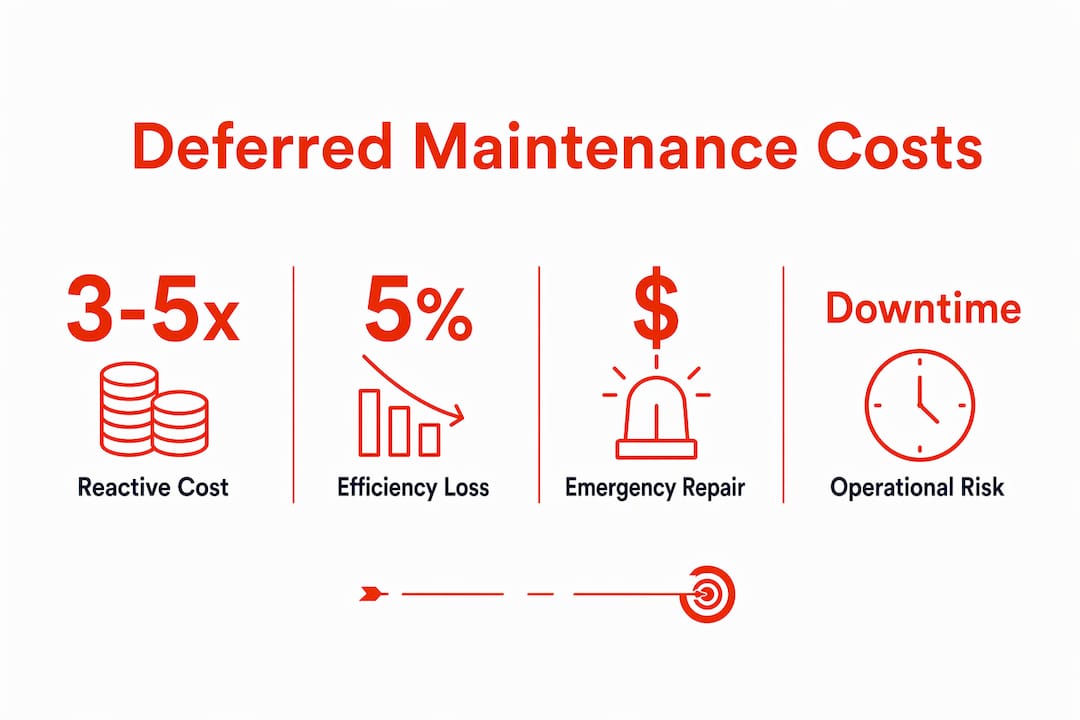
The core issue is that HVAC systems account for up to 40% of commercial building energy use. When maintenance slips, efficiency declines by about 5% per year, and that degradation accelerates wear on major components like chillers and compressors. What starts as a missed filter change or an unchecked refrigerant level quietly compounds into a capital replacement event.
The risk profile covers four interconnected areas:
- System efficiency loss: Dirty coils, clogged filters, and uncalibrated sensors force equipment to work harder, raising utility bills year over year.
- Premature equipment failure: Systems maintained regularly typically last many years; neglect can significantly shorten that lifespan.
- Compliance liability: Missing documentation and unaddressed refrigerant or water-treatment issues expose facilities to regulatory fines.
- Safety and health exposure: Poor air quality, carbon monoxide risks, and Legionella growth are direct consequences of neglected HVAC upkeep.
Key risks that come with delayed HVAC servicing
Deferred HVAC maintenance does not produce one clean failure. It produces a cascade, where each unaddressed problem stresses adjacent components until something breaks catastrophically.
The most consequential risks include:
- Energy inefficiency: Fouled coils, blocked outdoor air screens, and stuck dampers can collectively push HVAC energy penalties as high as 85% above baseline consumption in severe reactive-maintenance scenarios.
- Cascade failures: A $25 filter left unchanged can lead directly to a $2,500 blower motor failure. The math compounds fast when multiple tasks are overdue simultaneously.
- Accelerated equipment wear: Running a system under strain shortens component life across the board, from belts and bearings to compressors and heat exchangers.
- Indoor air quality decline: Dirty air handlers and stagnant condensate pans breed mold, bacteria, and particulates that circulate through occupied spaces. OSHA identifies poor indoor air quality as a serious occupant health concern.
- Legionella risk: Cooling towers and water-side HVAC components that go without basin cleaning create conditions where Legionella bacteria can proliferate, a risk the CDC tracks closely in building water systems.
- Regulatory non-compliance: Facilities without documented maintenance records face fines ranging from $10,000 to $268,000 for violations tied to Legionella prevention and EPA refrigerant regulations.
- Carbon monoxide hazards: Heating equipment that goes uninspected can produce dangerous CO levels without any visible warning sign until occupants are already affected.
The pattern that makes deferred HVAC maintenance risk particularly dangerous is that the early years look fine. Systems keep running. Nothing dramatic happens. That apparent stability is exactly what allows the backlog to grow until the failure is unavoidable and expensive.
Pro Tip: Track overdue tasks by component criticality, not just by how long they have been pending. A refrigerant check that is three months late on a chiller carries far more risk than a belt inspection that is six months late on a small air handler.
How deferred maintenance inflates costs and disrupts operations
The financial case against deferring HVAC maintenance is straightforward: reactive maintenance costs 3 to 5 times more than proactive scheduled maintenance over the life of a system. That multiplier comes from three sources: emergency labor premiums, expedited parts shipping, and the accelerated replacement cycles that follow cascade failures.
Energy waste adds a quieter but persistent cost. Inefficient equipment runs longer to meet the same load, which shows up directly on utility bills every month. Over a multi-year deferral period, those incremental overages often exceed what a full maintenance program would have cost.
Operational disruption compounds the financial damage. An unplanned chiller failure in July does not just mean a repair bill. It means occupant complaints, potential lease disputes, temporary cooling rentals, and lost productivity during downtime. For commercial properties, deferred maintenance signals to assessors that a building is in “fair” or “poor” condition, which affects both market value and assessed value. Tax appraisal adjustments rarely offset the actual capital and operational losses that follow.
For common commercial HVAC repair causes tied to delayed upkeep, the pattern is consistent: small neglected issues become the direct cause of the most expensive failures.
Strategies to reduce your deferred HVAC maintenance risk
The most effective way to control deferred maintenance risk is to stop treating HVAC upkeep as a discretionary budget line. Proactive maintenance is not a cost center. It is the mechanism that keeps emergency spending predictable and low.
Practical steps that work:
- Establish a written maintenance schedule tied to manufacturer specifications and ASHRAE standards, not just to when something looks broken.
- Prioritize the four highest-risk tasks first: coil cleaning, refrigerant charge verification, cooling tower basin cleaning, and condensate drain maintenance. These have the most asymmetric cost profiles.
- Implement a CMMS (Computerized Maintenance Management System) to log every task, track overdue items, and generate cost projections. Platforms in this category turn a vague backlog into a ranked list with dollar values attached.
- Document everything. Maintenance records are your primary defense in a regulatory audit and your evidence of due diligence if a warranty claim arises.
- Budget for catch-up repairs separately from routine maintenance. Facilities coming out of a deferral period need a one-time remediation budget before a standard preventive program can run cleanly.
- Schedule seasonal inspections before peak demand periods, specifically before summer cooling season and before winter heating loads hit.
A preventive maintenance schedule built around your specific equipment inventory is the single most reliable way to keep deferred risk from accumulating in the first place.
Pro Tip: When presenting a maintenance budget to leadership, attach the projected emergency repair cost for each deferred task. A $400 coil cleaning next to a $40,000 chiller replacement estimate is a far more persuasive argument than a general “preventive maintenance saves money” claim.
Expert insights and best practices for HVAC maintenance
Industry research from Lawrence Berkeley National Laboratory classifies HVAC maintenance into three tiers: proactive performance-monitored maintenance, preventive scheduled maintenance, and reactive unplanned maintenance. The tiers matter because they predict lifecycle cost, not just short-term spending. Proactive maintenance produces the lowest lifecycle cost. Reactive maintenance, the default in understaffed and underfunded facilities, produces the highest.
The insidious part of a reactive pattern is how it self-reinforces. After the first year of deferred maintenance, systems often appear to function normally. That apparent stability encourages a second year of deferral, then a third. Each year, small undetected problems worsen. By the time a failure is visible, the equipment has already lost years of useful life and the repair cost reflects it.
Best practices endorsed by facility management professionals:
- Conduct a full equipment audit before starting any new maintenance program to establish a true baseline.
- Use risk-weighted analytics to rank overdue tasks by projected cost differential, not just by age.
- Maintain complete service records for every piece of HVAC equipment, including sensor calibrations and refrigerant logs.
- Train building staff to recognize early warning signs: unusual noises, temperature inconsistencies, and unexpected utility bill spikes.
- Review maintenance contracts annually to confirm coverage matches current equipment inventory and building occupancy patterns.
Modern CMMS platforms give facility managers the ability to quantify deferred maintenance risk in dollar terms, which turns a maintenance conversation into a financial risk conversation. That shift in framing is often what secures budget approval.
Pro Tip: Use your CMMS data to build a “deferred maintenance liability” line in your annual budget presentation. Showing leadership a running total of deferred risk in dollar terms, rather than a list of overdue tasks, changes how quickly approvals come through.
Staying current on HVAC efficiency practices also helps facility managers catch efficiency losses early, before they compound into the kind of wear that requires major capital spending.
Key Takeaways
Deferred HVAC maintenance is not a cost deferral strategy. It is a cost multiplication strategy, where skipped tasks compound into emergency repairs that cost 3 to 5 times more than scheduled maintenance would have.
| Point | Details |
|---|---|
| Efficiency drops fast | Neglected HVAC systems lose efficiency by about 5% per year, raising operating costs steadily. |
| Lifespan cut nearly in half | Maintained systems last 15–20 years; neglected ones often fail after only 8–12 years. |
| Emergency cost multiplier | Reactive maintenance costs multiple times more than proactive scheduled maintenance over time. |
| Compliance fines are real | Regulatory violations tied to deferred maintenance can carry substantial fines. |
| Prioritize four key tasks | Coil cleaning, refrigerant checks, cooling tower cleaning, and condensate drain maintenance carry the highest risk-to-cost ratio. |
FAQ
What qualifies as deferred maintenance on an HVAC system?
Deferred maintenance is any manufacturer-recommended or code-required service task that has been postponed past its scheduled date. Common examples include coil cleaning, filter replacement, refrigerant charge verification, and cooling tower basin cleaning.
What are the biggest risks of skipping HVAC maintenance?
The primary risks are energy inefficiency, cascade equipment failures, indoor air quality decline, Legionella exposure, and regulatory fines. A neglected $25 filter, for example, can trigger a $2,500 blower motor failure.
Does deferred maintenance lower a property’s appraised value?
Yes. Tax assessors classify buildings with extensive deferred maintenance as “fair” or “poor” condition, which reduces both market and assessed value. The savings from skipped maintenance rarely offset the resulting valuation loss.
What are the warning signs of deferred HVAC maintenance?
Common signs include rising utility bills without a change in usage, inconsistent temperatures across zones, unusual equipment noises, frequent short-cycling, and visible dust or debris around air handlers and vents.
How can facility managers reduce deferred HVAC maintenance risk?
The most effective approach combines a written preventive maintenance schedule, a CMMS to track overdue tasks, complete service documentation, and a separate remediation budget for any existing backlog. Target Air Systems offers scheduled AC maintenance and furnace tune-up services designed to keep facilities ahead of deferred risk. Facility managers in the greater Boston area can request a quote to get a clear picture of where their system stands.