


Extending the HVAC lifespan in rental properties is defined as the practice of using scheduled maintenance, proper installation, and tenant cooperation to push equipment well beyond its default service life. A neglected system lasts 8–12 years. A well-maintained one lasts 15–20 years. That gap represents tens of thousands of dollars in avoided replacement costs across a rental portfolio. For landlords, the HVAC system is one of the most expensive assets in any unit, and the decisions you make about its care determine whether it becomes a recurring liability or a long-term investment.
What routine maintenance tasks extend HVAC lifespan in rental properties?
Scheduled preventive maintenance is the single most effective tool for prolonging HVAC life. Professional maintenance extends system life by 3–5 years, while reactive maintenance shortens it by 30–40%. That is not a marginal difference. It is the difference between replacing a unit at year 10 and replacing it at year 18.
The industry standard for rental properties is two professional tune-ups per year, scheduled in spring and fall. These visits cover coil cleaning, refrigerant level checks, electrical connection tightening, drain line flushing, and lubrication of moving parts. Two annual tune-ups cost $150–$500 per year, compared to $5,000–$12,000 for a full system replacement. The math is straightforward.
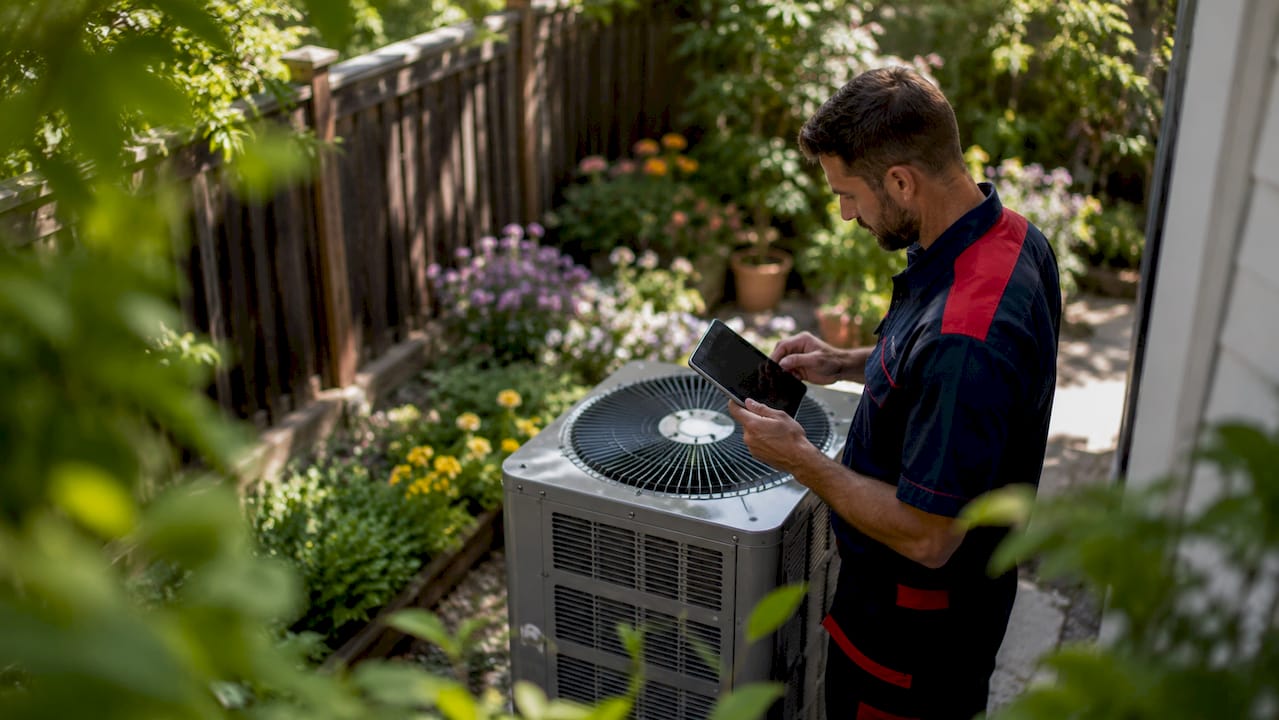
Between professional visits, filter maintenance is the highest-impact task a landlord can control. Filters need replacement every 30–90 days, with monthly changes required in dusty environments or units with pets. Clogged filters force the blower motor and compressor to work harder, generating heat and mechanical stress that accelerates wear. Most premature HVAC failures in rentals trace back to this single neglected task.
Beyond filters and tune-ups, two additional maintenance tasks protect the system from silent damage:
- Drain line cleaning: A blocked condensate drain causes water to back up into the air handler, leading to mold growth and component corrosion. Flush the line with a diluted bleach solution at each tune-up.
- Duct inspections: Leaky ducts force the system to run longer cycles to reach the thermostat setpoint. Sealing duct leaks reduces runtime and mechanical wear.
- Coil checks: Dirty evaporator and condenser coils reduce heat transfer efficiency, causing the compressor to overwork.
- Electrical connections: Loose terminals cause voltage fluctuations that burn out motors and control boards ahead of schedule.
For a complete task-by-task breakdown, the year-round maintenance checklist from Target Air Systems covers every interval landlords need.
Pro Tip: Schedule both annual tune-ups before tenant turnover periods. A freshly serviced system is less likely to fail during the first weeks of a new tenancy, which is when tenant impressions are formed.
How can landlords engage tenants to support HVAC care?
Tenant behavior directly affects how long an HVAC system lasts. A landlord can run a perfect maintenance program and still face early failure if tenants block vents, ignore filter changes, or run the thermostat at extreme settings. The solution is to build HVAC care into the tenancy from day one.
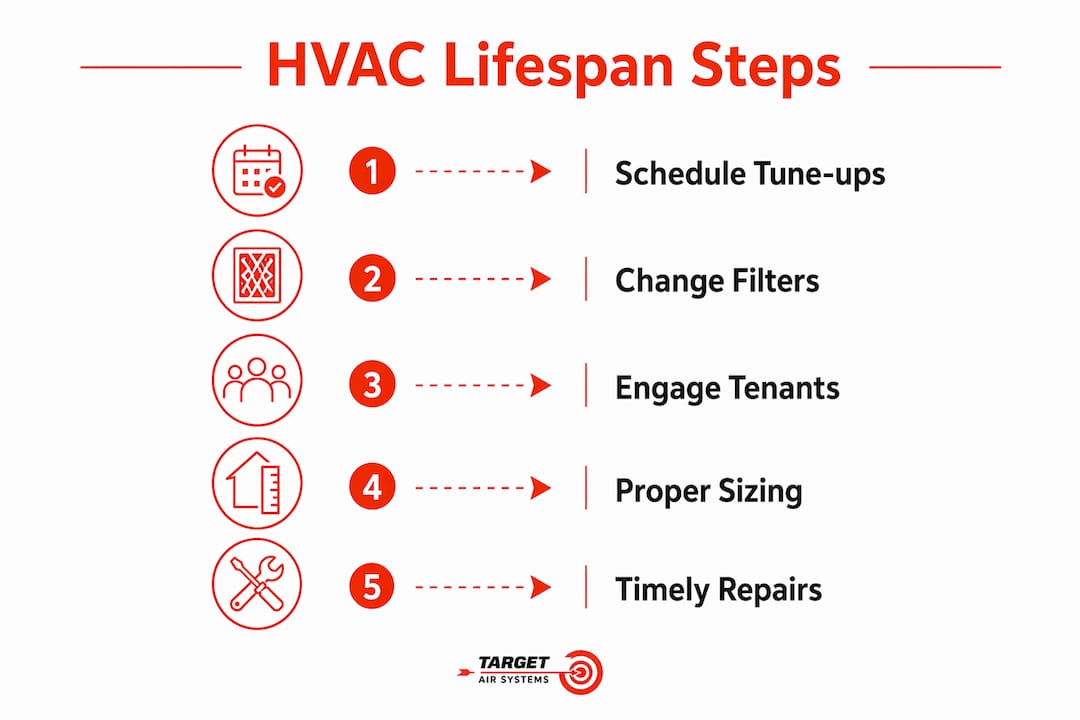
Including filter change requirements in the lease is the most reliable way to create compliance. A specific clause stating the replacement interval, the filter size, and the consequence for non-compliance turns a verbal expectation into a legal obligation. Tenants who sign that clause are far more likely to follow through.
Four steps make tenant engagement practical rather than theoretical:
- Supply the filters. Leave a six-month supply of the correct filter size in the unit at move-in. Removing the “I didn’t know what to buy” excuse eliminates the most common reason tenants skip changes.
- Send calendar reminders. A simple email or text reminder every 60 days costs nothing and produces measurable results. Property management platforms like Buildium and AppFolio support automated maintenance reminders.
- Educate on thermostat use. Tenants who set the thermostat to 62°F in summer or 80°F in winter create short-cycling conditions that stress the compressor. A one-page move-in guide covering acceptable temperature ranges prevents this.
- Respond to reported issues within 24 hours. Proactive resident education improves HVAC lifespan and reduces system abuse. Tenants who see fast responses report problems early, before small issues become expensive failures.
Pro Tip: Add a photo clause to your lease requiring tenants to send a photo of the installed filter every 90 days. It takes 30 seconds for the tenant and gives you documented proof of compliance.
What factors determine repair versus replacement for rental HVAC systems?
The repair-versus-replacement decision is a financial calculation, not a gut feeling. The industry standard is the $5,000 rule: multiply the repair cost by the system’s age. If the result exceeds $5,000, replacement is the financially sound choice. A $400 repair on a 10-year-old system produces $4,000, which falls below the threshold. A $600 repair on a 12-year-old system produces $7,200, which signals replacement.
Age and cumulative repair history matter equally. Tracking repair costs against replacement cost for systems over 10–12 years old helps landlords identify when continued repairs become financially unrecoverable. A system that has consumed $3,000 in repairs over two years is telling you something the $5,000 rule alone does not capture.
| Decision factor | Repair | Replace |
|---|---|---|
| System age | Under 10 years | Over 12 years |
| Repair cost × age | Under $5,000 | Over $5,000 |
| Annual repair frequency | One incident | Two or more incidents |
| Refrigerant type | R-410A (current) | R-22 (phased out) |
| Energy efficiency rating | SEER 14 or higher | Below SEER 13 |
R-22 refrigerant is no longer manufactured in the United States. Systems that still use it face escalating repair costs because the refrigerant itself is scarce and expensive. That factor alone often tips the calculation toward replacement, regardless of age.
For a deeper breakdown of these criteria, Target Air Systems publishes a guide on HVAC repair vs replacement that walks through all eight decision factors with real cost examples.
What installation and upgrade practices improve HVAC longevity?
The lifespan of an HVAC system is partly determined before it ever runs. Installation quality and system sizing set the ceiling for how long a unit can last, regardless of how well it is maintained afterward.
Proper sizing using a Manual J load calculation is the most critical installation factor. An oversized system short-cycles, meaning it reaches the thermostat setpoint too quickly, shuts off, and restarts repeatedly. Each startup cycle stresses the compressor. An undersized system runs continuously without reaching setpoint, overheating motors and wearing components faster. Both failure modes shorten lifespan significantly.
Beyond sizing, three upgrades deliver measurable lifespan and efficiency gains:
- Programmable or smart thermostats: These prevent the extreme temperature swings that cause short-cycling. They also give landlords remote visibility into system behavior between visits.
- Duct sealing and insulation: Sealed ducts reduce runtime by delivering conditioned air where it is needed. Less runtime means less wear.
- High-efficiency air handlers: Pairing a quality air handler with a new condenser unit prevents the mismatched-component problem that causes premature failure on one side of the system.
Well-maintained systems achieve 5%–15% higher energy efficiency, which reduces tenant utility bills and improves retention. That efficiency gain is compounded when the underlying installation is correct. A properly sized, well-maintained system running in sealed ducts performs at a level that a poorly installed system cannot reach regardless of maintenance frequency.
Pro Tip: Always request a copy of the Manual J calculation from any contractor installing a new system in a rental unit. If they cannot produce one, find a contractor who can.
What common mistakes shorten HVAC lifespan in rentals?
Reactive maintenance is the most expensive approach a landlord can take. Waiting for a system to fail before calling a technician guarantees that minor issues compound into major failures. A refrigerant leak caught at a tune-up costs a few hundred dollars to fix. The same leak, left undetected for a season, destroys the compressor.
The most common mistakes that shorten HVAC life in rental properties:
- Skipping filter replacements: Clogged filters are the leading cause of premature compressor and motor failure in rental units.
- Ignoring tenant thermostat abuse: Extreme settings create short-cycling and continuous-run conditions that wear out components in months, not years.
- Skipping drain line maintenance: Blocked condensate drains cause water damage to air handlers and create mold conditions that require full unit remediation.
- Delaying reported repairs: A tenant reports warm air in july. The landlord waits two weeks. The compressor fails. A $200 refrigerant recharge becomes a $3,500 compressor replacement.
- Using the wrong filter size or MERV rating: An overly restrictive filter (MERV 13 or higher) in a system not designed for it restricts airflow as severely as a clogged filter.
Pro Tip: Set a calendar alert for the 15th of every month to check whether any tenant has submitted a maintenance request related to HVAC. Early detection is the cheapest form of repair.
Key Takeaways
Proactive HVAC maintenance in rental properties extends system life by 3–5 years, cuts replacement costs, and directly improves tenant satisfaction and retention.
| Point | Details |
|---|---|
| Schedule two tune-ups yearly | Spring and fall professional service costs $150–$500 and prevents $5,000–$12,000 replacements. |
| Replace filters every 30–90 days | Clogged filters cause most premature HVAC failures; supply filters to tenants to ensure compliance. |
| Use the $5,000 repair rule | Multiply repair cost by system age; replace when the result exceeds $5,000. |
| Size systems with Manual J | Correct sizing prevents short-cycling, the leading installation-related cause of early failure. |
| Engage tenants through lease clauses | Written filter change requirements and fast repair responses turn tenants into maintenance partners. |
What I’ve learned after years of watching landlords get this wrong
Most landlords treat HVAC the way they treat smoke detectors: check it once a year, hope it works, and panic when it does not. That approach costs far more than the maintenance it avoids.
The landlords I have seen manage HVAC well share one habit. They treat it as a capital asset with a predictable service life, not as a black box that either works or does not. They keep a simple spreadsheet: system age, last service date, cumulative repair spend, and estimated replacement year. That spreadsheet takes 10 minutes to build and saves thousands in emergency decisions.
The tenant engagement piece surprises most landlords when they actually try it. Providing filters at move-in and sending a 60-day reminder email feels like a small gesture. The compliance rate it produces is not small. Tenants who receive filters and reminders change them. Tenants who are told to “handle it themselves” often do not.
The hardest lesson is this: the landlords who resist spending $300 on a fall tune-up are often the same ones spending $8,000 on an emergency replacement in february. The math is not complicated. The behavior change is. Tracking repair costs across your portfolio makes the pattern visible and removes the temptation to defer service.
— Warren
How Target Air Systems helps landlords protect their HVAC investment
Target Air Systems works directly with rental property owners across the Natick, MA area to build maintenance programs that fit real portfolios. Their certified technicians handle bi-annual furnace tune-ups and AC services with upfront pricing and no hidden fees, so you always know what you are spending before work begins. Every service visit is documented, which protects manufacturer warranties and gives you a paper trail for tenant disputes. Landlords who want to stop reacting to HVAC failures and start preventing them can request a quote for a maintenance plan built around their specific properties.
FAQ
How long does a well-maintained HVAC system last in a rental?
A well-maintained HVAC system lasts 15–20 years. Neglected systems typically fail at 8–12 years, cutting service life nearly in half.
How often should HVAC filters be changed in a rental unit?
Filters should be replaced every 30–90 days. Monthly replacement is best in units with pets or high dust levels to prevent compressor failure.
What is the $5,000 rule for HVAC repair decisions?
Multiply the repair cost by the system’s age in years. If the result exceeds $5,000, replacement is the more financially sound choice than continued repair.
Can tenant behavior really affect HVAC lifespan?
Yes. Blocked vents, extreme thermostat settings, and skipped filter changes are leading causes of premature HVAC failure in rental units. Lease clauses and supplied filters significantly reduce these risks.
Does proper HVAC sizing affect how long the system lasts?
Correct sizing using a Manual J load calculation prevents short-cycling and continuous-run conditions that wear out compressors and motors years ahead of schedule.