


An HVAC error code is a diagnostic signal your heating or cooling system displays when it detects an abnormal condition it cannot safely ignore. These codes are the industry term for what technicians call “fault codes,” and understanding hvac error codes is the fastest way to know whether you need a filter swap or an emergency service call. Heating and cooling account for about 43% of a home’s utility bill, so a system that shuts down over an unresolved fault code costs you money every hour it sits idle. Knowing what does hvac error code mean puts you in control of that situation before it gets expensive.
What do common HVAC error codes mean?
HVAC error codes are not random numbers. Each code maps to a specific component failure, safety lockout, or out-of-range condition your system’s control board detected. The codes vary by system type, but the logic is consistent: the board monitors sensors, and when a reading falls outside safe limits, it throws a code and often shuts down to prevent damage.

Common codes and what they signal
The most frequently seen codes across residential systems fall into a few categories:
- E1 / E2: Thermostat or communication errors between the indoor and outdoor units. These often point to wiring faults or a failing control board.
- E3: Low refrigerant pressure. The system detected suction pressure below the safe threshold, which usually means a refrigerant leak or a failing metering device.
- F1: Ignition failure on a furnace. The burner attempted to light and failed, triggering a safety lockout.
- Airflow and pressure codes: These appear when the system senses restricted airflow, a clogged filter, or a blocked flue.
- Sensor codes: A failed thermistor or pressure transducer sends a bad signal to the board, which reads it as a fault.
Common furnace fault codes include Code 13 (limit switch lockout), Code 24 (secondary voltage fuse open), Code 31 (pressure switch stuck open), Code 33 (limit switch fault), and Code 41 (blower motor fault). Each of these points to a specific safety or component issue that requires a different repair approach.
| Code | Common cause | Typical action |
|---|---|---|
| E1 / E2 | Thermostat or communication fault | Check wiring; call a tech if wiring looks intact |
| E3 | Low refrigerant pressure | Professional refrigerant check required |
| F1 | Ignition failure | Inspect flame sensor; call a tech for gas work |
| Code 13 | Limit switch lockout | Check airflow and filter; tech needed if it repeats |
| Code 31 | Pressure switch stuck open | Inspect flue and drain lines; tech for persistent faults |
| Code 41 | Blower motor fault | Professional motor diagnosis required |
Pro Tip: Take a photo of the error code on your thermostat or air handler display before you reset the system. Technicians use that code to start their diagnosis, and clearing it before they arrive can slow the process down.
How do manufacturer-specific codes vary by brand?
HVAC error codes are not universal across brands. The same code number can mean completely different things depending on who made your system. A “31” on one brand flags a pressure switch fault. On another brand, “31” may indicate a gas valve error. Relying on a generic online list without confirming your brand and model is one of the most common mistakes homeowners make.
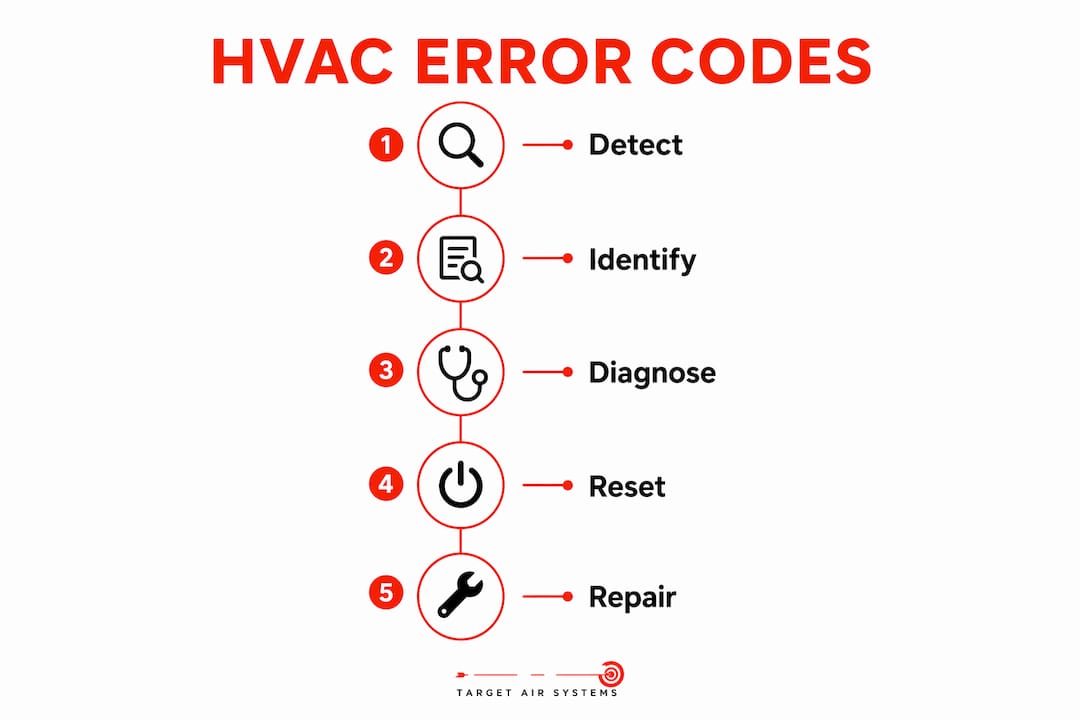
How to find the right code definition for your unit
Follow these steps to decode your specific system’s fault code accurately:
- Locate your model number. It appears on the data tag, usually on the inside of the air handler door, on the outdoor condenser cabinet, or on the furnace cabinet near the burner access panel.
- Pull the manufacturer’s manual. Most brands post full manuals and fault code tables on their websites. Search your model number plus “fault code list” or “error code table.”
- Check the inside of the access panel. Many manufacturers print a simplified fault code chart directly on the inside of the unit’s door. Open the panel and look before you search online.
- Contact the manufacturer’s technical support line. If the manual is unclear, the manufacturer’s tech line can confirm what a code means for your specific model and production year.
Careful cross-referencing with manufacturer manuals is the only reliable way to avoid misdiagnosis. Generic code lists circulate widely online, but they are written for broad audiences and frequently omit brand-specific nuances that change the repair entirely.
When should you troubleshoot yourself vs. call a professional?
Homeowners can safely handle a short list of checks without tools or training. Everything beyond that list carries real risk, and some tasks carry legal restrictions.
Safe DIY checks you can do right now
- Check and replace the air filter if it is gray and clogged.
- Confirm the thermostat is set to the correct mode (heat or cool) and the temperature is set above or below the current room temperature.
- Check that all supply and return vents in the home are open and unblocked.
- Verify the system’s circuit breaker is in the “on” position. Reset it once if it tripped, but do not reset it a second time if it trips again.
- Clear debris from around the outdoor condenser unit.
When to stop and call a technician
Professional diagnostic visits cost $80–$200, which is a fraction of what improper DIY repairs can cost. Guessing at part replacements without diagnostic data can lead to over $2,000 in unnecessary damage. Call a licensed technician immediately when you encounter any of the following:
- A gas smell near the furnace or anywhere in the home. Evacuate and call 911 first.
- A carbon monoxide detector alarm. Leave the house and call emergency services before calling your HVAC company.
- A circuit breaker that trips more than once after a reset. Repeated breaker trips signal a serious electrical fault.
- Any error code related to refrigerant. Handling refrigerant without an EPA Section 608 certification is illegal for homeowners.
- Electrical components inside the air handler or furnace cabinet. Capacitors hold lethal voltage even after the system powers off.
Pro Tip: Keep a simple log of every error code your system throws, including the date and what the weather was doing. A pattern of codes under the same conditions tells a technician far more than a single code read in isolation.
The HVAC diagnostic process a licensed technician follows goes well beyond reading the code. It includes measuring system pressures, temperatures, and electrical values to confirm what the code is pointing at.
What do error codes tell you about repair vs. replacement?
An error code is not just a repair trigger. It is a window into your system’s overall health. Repeated codes for the same component, or codes that appear across multiple systems at once, often signal that the equipment is approaching the end of its useful life.
Reading codes as maintenance signals
- Airflow restriction codes (clogged filter, blocked coil) are maintenance failures. They are cheap to fix but expensive if ignored because they force the compressor and heat exchanger to work beyond their design limits.
- Pressure fault codes often indicate refrigerant loss, which means a leak exists somewhere in the system. Leaks do not fix themselves.
- Motor fault codes on older equipment frequently mean the motor is failing from age, not a single incident. Replacing a motor on a 15-year-old system may not be the best use of money.
- Limit switch and heat exchanger codes deserve serious attention. A cracked heat exchanger is a carbon monoxide risk, and replacement of the heat exchanger often costs more than a new furnace.
The Rule of 5000 gives homeowners a practical framework for repair versus replacement decisions. Multiply the repair cost by the equipment’s age in years. If the result exceeds 5,000, replacement is usually the better financial choice. A $400 repair on a 10-year-old system scores 4,000, which favors repair. A $600 repair on a 12-year-old system scores 7,200, which favors replacement.
Routine furnace maintenance and tune-ups catch the conditions that trigger fault codes before they become shutdowns. A technician measuring system pressures and temperatures during a tune-up can spot a refrigerant charge drifting low or a heat exchanger showing stress before a code ever appears.
Proper HVAC diagnosis involves mapping superheat and subcooling values to identify refrigerant charge or airflow problems. Typical residential cooling superheat runs around 10°F, and deviations from that number point directly to undercharge, overcharge, or airflow restriction. That kind of data turns a vague error code into a specific, confirmed diagnosis.
Key Takeaways
HVAC error codes are diagnostic tools that tell you exactly which system condition triggered a shutdown, and reading them correctly determines whether you spend $20 on a filter or $2,000 on an unnecessary repair.
| Point | Details |
|---|---|
| Error codes are fault-specific signals | Each code maps to a component failure or out-of-range condition, not a general “something is wrong” warning. |
| Codes are brand-specific | The same code number means different things on different equipment; always verify with your manufacturer’s manual. |
| DIY has clear limits | Homeowners can check filters and vents safely, but refrigerant, gas, and electrical faults require a licensed technician. |
| Codes inform repair vs. replacement | Use the Rule of 5000 to evaluate whether fixing a fault-code-triggered repair makes financial sense on aging equipment. |
| Documented readings beat guesswork | A technician who shares pressure and temperature readings gives you proof of diagnosis, not just a parts estimate. |
What I’ve learned from watching homeowners misread their own systems
The most expensive mistake I see homeowners make is treating an error code as a parts list. They look up “E3 error code” online, read that it means low refrigerant, and call a technician asking for a refrigerant recharge. The technician adds refrigerant, charges for the service, and two weeks later the same code is back. The refrigerant did not disappear on its own. There was a leak the whole time, and nobody measured for it.
Good technicians provide diagnostic readings as evidence for their diagnosis. Pressure readings, superheat values, temperature splits. If a technician cannot show you numbers that explain why they are recommending a specific repair, that is a problem worth questioning.
The other thing I have seen homeowners underestimate is the value of a repair log. A single fault code tells you something happened. A log of six fault codes over two heating seasons tells you the system is trending toward failure. That log is also useful when you are deciding whether to repair or replace, because it gives you a real history instead of a gut feeling.
Homeowners often underestimate the risks of DIY HVAC repair. Legal restrictions around refrigerant and the genuine danger of capacitors and gas components make professional help necessary for anything beyond the basic checks. Knowing where that line is does not make you less capable. It makes you a smarter homeowner.
— Warren
Professional HVAC diagnosis from Target Air Systems
When an error code appears and the basic checks do not clear it, the next step is a professional diagnosis from a technician who can measure what the code is pointing at. Target Air Systems provides full HVAC diagnostics and repair for homeowners across the greater Natick, MA area, with upfront pricing and no payment required until the work is complete. Their screened, certified technicians bring the tools and training to read system pressures, confirm fault causes, and give you a clear answer before any repair begins. Whether the issue is a pressure fault, a motor code, or a recurring ignition failure, Target Air Systems handles it with documented accuracy and a track record of 5-star service.
FAQ
What does an HVAC error code mean?
An HVAC error code is a fault signal displayed by your system’s control board when a sensor reading falls outside safe operating limits. The code identifies which component or condition triggered the shutdown so a technician or homeowner can address the specific problem.
Are HVAC error codes the same for every brand?
No. HVAC error codes are manufacturer-specific, and the same code number can indicate completely different problems on different brands. Always verify any code against your unit’s model number and the manufacturer’s official fault code table.
Can I reset an HVAC error code myself?
You can reset most systems by switching the thermostat off and back on, or by cycling the circuit breaker. However, if the same code returns after a reset, the underlying problem still exists and requires professional diagnosis.
When is an HVAC error code a safety emergency?
A gas smell, a carbon monoxide alarm, or a circuit breaker that trips repeatedly after a reset are all emergencies. Evacuate the home and call 911 before contacting any HVAC service.
How much does professional HVAC diagnosis cost?
Professional diagnostic visits typically cost $80–$200. That fee is far less than the cost of incorrect DIY repairs, which can exceed $2,000 in component damage when the wrong part is replaced without confirmed diagnostic data.