


An HVAC audit is a data-driven assessment of your home’s heating, cooling, and ventilation systems, designed to find energy waste and maintenance problems before they cost you more money. Understanding what does an HVAC audit involve gives you a clear picture of where your energy dollars go and what repairs will deliver the fastest payback. The industry term for this process is a “home energy audit,” though many technicians and homeowners use “HVAC audit” when the focus is specifically on heating and cooling performance. A thorough audit uses calibrated diagnostic tools, not guesswork, to produce a prioritized action plan. Target Air Systems performs these evaluations for homeowners across Massachusetts who want real answers about their system’s efficiency.
What are the main steps in an HVAC audit?
An HVAC audit follows a structured sequence of tests and inspections, each building on the last to create a complete picture of your home’s energy performance. Skipping any step leaves gaps that a visual inspection alone cannot fill.
1. Utility data review
The auditor starts by collecting 12 months of energy bills and any available maintenance records. This baseline reveals consumption patterns, seasonal spikes, and whether your system is working harder than it should. Preparing this data before the auditor arrives shortens the appointment and sharpens the analysis.
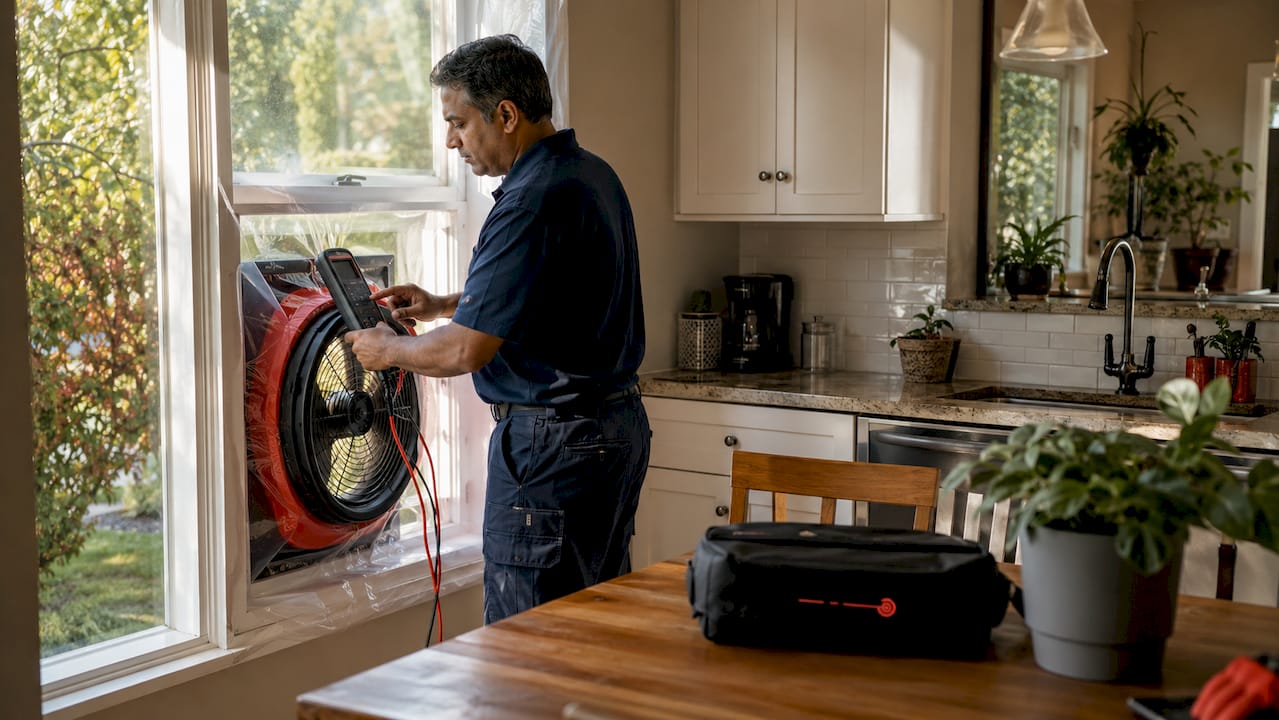
2. Blower door test
The auditor seals your home and uses a calibrated fan mounted in an exterior doorframe to depressurize the house to 50 pascals. This controlled pressure difference amplifies hidden air leaks, making them detectable by feel, sound, or smoke pencil. The result is an ACH50 measurement, which quantifies how many times per hour your home’s entire air volume leaks out. A high ACH50 number means your HVAC system is constantly fighting air loss it cannot win.
3. Duct blaster test
A duct blaster connects to your duct system and pressurizes it independently of the living space. The test measures leakage in CFM25, which is the volume of air escaping the ducts at 25 pascals of pressure. Duct leakage accounts for a significant share of HVAC energy waste, with leaky ducts forcing your equipment to run longer cycles to compensate.
4. Thermal imaging scan
The auditor uses an infrared camera to scan walls, ceilings, and floors. The camera maps temperature differences across surfaces, revealing missing insulation, air gaps, and moisture intrusion that no visual inspection can detect. Thermal imaging is particularly effective when there is a temperature difference of at least 15°F between inside and outside.
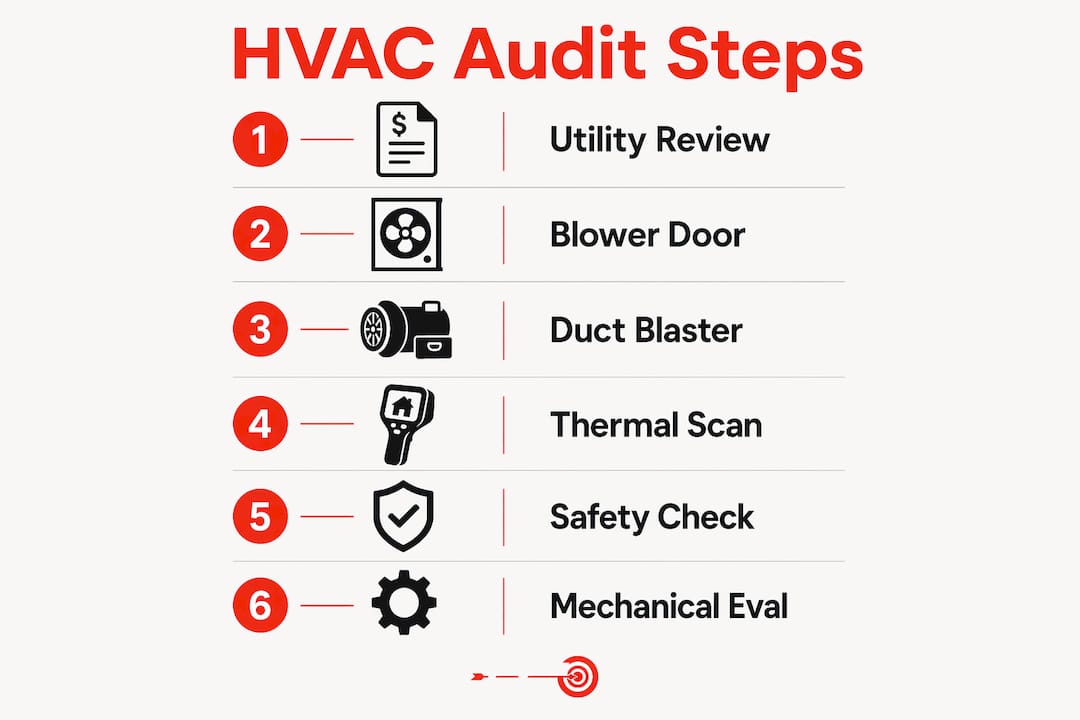
5. Combustion safety check
For homes with gas or oil appliances, the auditor tests for carbon monoxide and backdrafting. Backdrafting occurs when exhaust gases reverse direction and enter the living space, a serious safety hazard that a basic service call rarely catches.
6. Mechanical inspection
The auditor checks your furnace, air handler, and cooling equipment for dirty coils, worn belts, refrigerant pressure issues, and airflow restrictions. This step connects the building envelope findings to the mechanical system’s actual workload.
Pro Tip: Clear access to your attic, basement, and utility closet before the auditor arrives. Blocked access points add time and can prevent key tests from being completed.
How does an HVAC audit identify energy inefficiencies?
Audit results translate raw measurements into specific problems with known energy impacts. The ACH50 and CFM25 numbers are not just data points. They tell you exactly how much conditioned air your home loses and where it goes.
The building envelope is the most common source of HVAC inefficiency. Addressing air leaks and insulation can reduce your heating and cooling load by 10–20%, which sometimes means you can right-size to a smaller, less expensive system at replacement time. That is a finding no routine service call will surface.
Thermal imaging adds another layer of specificity. A cold spot on a ceiling scan points to missing attic insulation directly above it. A warm patch on a wall in summer points to an air gap or missing batt. The camera turns invisible problems into visible, addressable targets.
Common inefficiencies found during a full audit include:
- Duct leaks into unconditioned spaces such as attics or crawl spaces, where conditioned air is simply lost
- Missing or compressed insulation in attic floors, rim joists, and exterior walls
- Air bypasses around recessed lights and plumbing penetrations that short-circuit the building envelope
- Dirty evaporator or condenser coils that reduce heat transfer efficiency and raise energy consumption
- Oversized or undersized HVAC equipment that short-cycles or runs continuously without reaching setpoint
- Blocked or unbalanced duct runs that create hot and cold zones throughout the home
Each item on that list carries a measurable energy cost. The audit report assigns estimated savings to each fix, so you know which repairs pay back fastest.
What should homeowners expect as audit outcomes?
The audit delivers a prioritized written report, not just a list of problems. Auditors provide estimated costs, projected savings, and return-on-investment rankings for each recommended improvement. That structure lets you act on the highest-value fixes first, even if budget limits what you can do immediately.
Air sealing and attic insulation consistently rank at the top of these reports. These improvements typically pay back within 1–3 years and cut HVAC energy use by 15–30%. Equipment upgrades come later in the priority order, because fixing the envelope first means any new equipment you install will be properly sized for the actual load.
| Audit component | Typical improvement | Expected outcome |
|---|---|---|
| Air sealing | Reduce ACH50 by 30–50% | Lower heating and cooling bills |
| Attic insulation | Bring to R-38 or R-49 | Reduced heat gain and loss |
| Duct sealing | Cut CFM25 leakage by 50%+ | More even temperatures, less runtime |
| Equipment tune-up | Restore rated efficiency | Lower energy use per cycle |
| Combustion safety fix | Eliminate backdrafting risk | Safer indoor air quality |
A professional audit for a single-family home typically costs $200–$600 and takes 2–4 hours. Utility rebate programs in many states reduce that cost to $0–$150, making the audit one of the lowest-cost, highest-return investments a homeowner can make. Most homeowners recover the audit fee through lower energy bills within 1–2 years.
Pro Tip: Ask your utility company about rebate programs before scheduling. Many Massachusetts utilities offer subsidized audits that cover most or all of the cost.
How does an HVAC audit differ from a routine inspection?
A routine HVAC system inspection and a full energy audit are not the same thing. Knowing the difference prevents you from paying for one when you need the other.
A standard HVAC performance evaluation focuses on mechanical measurements: refrigerant pressure, electrical current draw, and component condition. It tells you whether your equipment is working correctly today. It does not tell you whether your building envelope is undermining that equipment’s efficiency.
A full energy audit evaluates both the mechanical system and the building it serves. The key distinctions are:
- Calibrated equipment required. Blower door and duct blaster tests require certified tools and trained operators. A visual-only inspection is not a proper audit, regardless of who performs it.
- Quantitative output. An audit produces ACH50 and CFM25 numbers. A basic inspection produces a technician’s observations. Numbers allow you to track improvement over time.
- Certified auditors. Organizations like BPI (Building Performance Institute) and RESNET set the training and equipment standards that qualified auditors must meet. Certification is not optional if you want a report that qualifies for utility rebates.
- Scope of recommendations. An audit recommends building envelope fixes alongside mechanical ones. A service inspection recommends repairs to the equipment it examined.
DIY energy checks and free contractor walk-throughs lack the calibrated tools and training to generate a prioritized energy conservation plan. They can identify obvious problems, but they miss the hidden leaks and insulation gaps that drive the largest energy losses.
Key Takeaways
A professional HVAC audit uses calibrated diagnostic tools to identify energy waste, safety hazards, and maintenance needs that routine inspections consistently miss.
| Point | Details |
|---|---|
| Audit scope | Covers building envelope, duct system, mechanical equipment, and combustion safety in one visit. |
| Core diagnostic tools | Blower door, duct blaster, and thermal imaging camera produce quantitative data no visual check can match. |
| Top energy fixes | Air sealing and attic insulation pay back in 1–3 years and cut HVAC energy use by 15–30%. |
| Audit cost | Expect $200–$600 for a full audit; utility rebates can reduce this to near zero. |
| Certification matters | Use BPI- or RESNET-certified auditors to qualify for rebates and get a credible, data-backed report. |
Why I think most homeowners wait too long for an audit
After years of watching homeowners replace furnaces and air conditioners without fixing the real problem, I have a clear opinion: most HVAC equipment upgrades happen before the building envelope is ready for them. A new high-efficiency furnace installed in a leaky, under-insulated house will never perform at its rated efficiency. The equipment is not the problem. The house is.
The audit flips that sequence. It tells you what the building actually needs before you spend money on equipment. I have seen HVAC diagnostic findings reveal that a home’s duct system was losing nearly a third of conditioned air into an unconditioned attic. The homeowner had been blaming the furnace for years. The furnace was fine.
The other misconception I hear constantly is that audits are only worth it for older homes. That is wrong. New construction has its own air sealing failures, duct installation shortcuts, and insulation gaps. An audit on a five-year-old home can surface problems that were baked in during construction and have been costing money ever since.
My practical advice: pair your audit findings with a solid year-round maintenance plan so the improvements you make stay effective. An audit is a snapshot. Maintenance keeps that snapshot from degrading.
— Warren
Target Air Systems can help you schedule a professional HVAC audit
Target Air Systems works with homeowners across Massachusetts to identify exactly where their heating and cooling systems are losing efficiency. The team of screened, certified technicians brings the diagnostic tools and training needed to produce a report you can actually act on. There are no hidden fees and no pressure to buy equipment you do not need. If you are ready to find out what your system is really doing, request a quote and get a clear picture of your home’s energy performance. Target Air Systems also serves homeowners in Canton and surrounding communities with the same upfront, no-surprise approach.
FAQ
What does an HVAC audit involve at a basic level?
An HVAC audit involves a blower door test, duct leakage test, thermal imaging scan, combustion safety check, and mechanical inspection, all producing a prioritized report of energy-saving improvements.
How long does a home energy audit take?
A professional audit for a single-family home typically takes 2–4 hours, depending on the home’s size and the number of diagnostic tests performed.
How much does an HVAC energy audit cost?
A full audit costs $200–$600 without incentives. Utility rebate programs in many states reduce that cost to $0–$150 for qualifying homeowners.
Do I need a certified auditor for an HVAC energy efficiency assessment?
Yes. BPI- and RESNET-certified auditors use calibrated equipment and meet training standards required for utility rebate eligibility. A visual-only inspection does not qualify.
How often should homeowners schedule an HVAC audit?
Most energy professionals recommend an audit every 5–7 years, or any time you notice significant increases in energy bills, uneven temperatures, or plan a major renovation.