


A structured HVAC preventive maintenance schedule is the single most effective tool property managers have for controlling building operating costs and extending equipment life. Proactive maintenance programs reduce total HVAC costs by 40–60% and generate 300–500% ROI by cutting repairs, energy waste, and premature replacements. The industry baseline calls for professional service at least twice per year, with monthly filter checks and visual inspections in between. Buildings that skip this structure pay for it in emergency repairs, shortened equipment life, and rising energy bills.
1. What is the standard HVAC preventive maintenance schedule for buildings?
The baseline for most commercial buildings is professional HVAC service twice per year: once in spring before cooling season and once in fall before heating season. This biannual service standard is the recognized industry minimum for average commercial facilities with standard occupancy and equipment age. Each visit covers a defined set of tasks that keep systems running at rated efficiency.
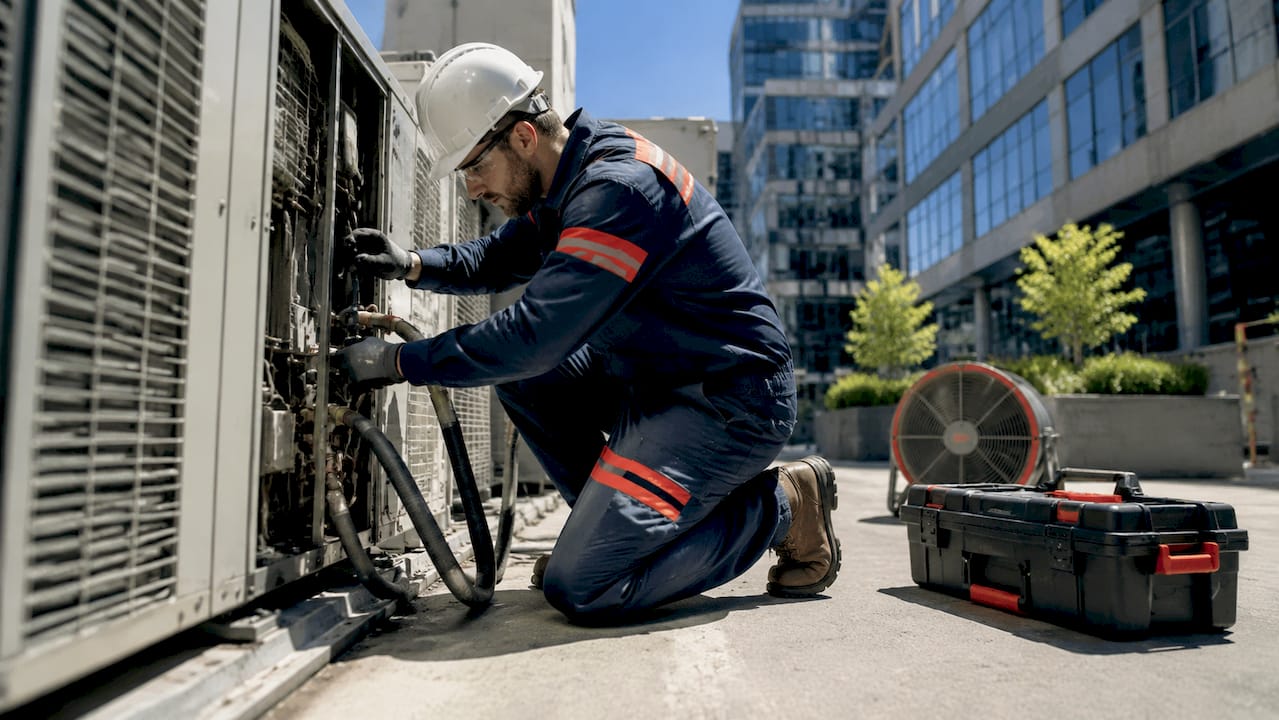
A typical spring visit focuses on the cooling side of the system. Technicians check refrigerant levels, clean evaporator and condenser coils, test electrical connections, and calibrate controls. A fall visit shifts to the heating side: heat exchangers, burners, flue systems, and safety controls all get inspected and tested. Both visits include a full performance benchmark so the next visit has a baseline for comparison.
Key tasks completed during each biannual visit:
- Refrigerant level check and leak inspection
- Evaporator and condenser coil cleaning
- Electrical connection tightening and amperage testing
- Controls and thermostat calibration
- Drain pan and condensate line clearing
- Blower motor and belt inspection
- Safety control and shutoff testing
- System performance benchmarking
Pro Tip: Schedule your spring visit in march or early april, before the first heat wave hits. Emergency calls spike in june, and technician availability drops. Booking early locks in preferred appointment times and avoids peak-season delays.
2. When should maintenance frequency increase beyond twice per year?
The biannual baseline suits average office buildings and light commercial spaces. Buildings with high occupancy, specialized environments, aging equipment, or heavy runtime need more frequent service. Facilities with heavier system usage should increase to quarterly or monthly inspections to detect slow efficiency trends and control drift before they become emergency repairs.
Sectors that consistently require quarterly or monthly service include:
- Restaurants and commercial kitchens: Grease-laden air clogs filters and coils rapidly.
- Healthcare facilities: Air quality standards and infection control require tight humidity and filtration control.
- Manufacturing plants: Dust, chemical vapors, and heat loads stress equipment far beyond office conditions.
- High-rise residential buildings: Roof units and corridor systems run continuously and serve dense populations.
- Data centers: Precision cooling systems cannot tolerate temperature drift, requiring monthly checks at minimum.
Equipment age is a major driver of frequency decisions. Systems older than 15 years lose efficiency faster and develop faults more often. Increasing service visits on aging equipment is cheaper than emergency replacements.
“Higher frequency inspections detect slow trends in energy use and control drift earlier, minimizing emergency repairs and keeping systems performing within design parameters. Standard schedules are starting points; effective programs tailor intervals based on environmental and operational factors that uniform schedules miss.”
3. HVAC maintenance tasks organized by frequency interval
A complete commercial HVAC maintenance plan assigns every task to a specific interval. This structure prevents both over-servicing and dangerous gaps. Daily and weekly visual checks combined with monthly professional tasks and biannual deep servicing is the recommended structure for most commercial buildings.
Daily and weekly tasks (in-house staff)
Most daily and weekly checks require no certification. Building staff can handle these without a service call.
- Check thermostat setpoints and confirm systems are running on schedule.
- Listen for unusual noises from air handlers, rooftop units, and ductwork.
- Inspect condensate drain pans for standing water.
- Verify supply and return air temperatures match expected ranges.
- Log any alarms or fault codes from building automation systems.
Monthly tasks
| Task | Who performs it | What to check |
|---|---|---|
| Filter inspection and replacement | In-house or contractor | Pressure drop, visible clogging, correct MERV rating |
| Blower belt tension check | In-house | Wear, cracking, proper tension |
| Condensate drain flush | In-house | Clear flow, no blockage or odor |
| Electrical panel visual check | In-house | No burn marks, tripped breakers |
| Coil visual inspection | In-house | Surface fouling, fin damage |
A two-tier approach where junior staff handle monthly walkdowns for simple tasks reduces service fees and keeps professional visits focused on high-skill work. Relying solely on contractors for every task increases costs without improving outcomes.
Quarterly tasks (certified technician required)
Refrigerant checks, electrical connection testing, controls calibration, and motor amperage readings all require a licensed technician. These tasks catch problems that visual inspections miss. Quarterly visits also include a performance comparison against the previous benchmark to spot efficiency degradation early.
Annual tasks
Full duct inspections, heat exchanger integrity tests, compressor oil analysis, and complete controls system audits belong on the annual calendar. These tasks take longer and require specialized equipment. Scheduling them during low-occupancy periods, such as holiday shutdowns, minimizes disruption.
Pro Tip: Use a CMMS platform to automate task assignments and generate compliance-ready reports. Digital scheduling eliminates missed visits and gives you timestamped records for warranty claims and audits.
4. How to customize HVAC schedules using a tiered priority system
Not every piece of HVAC equipment in a building carries equal business risk. A tiered maintenance strategy allocates resources based on what each system’s failure would actually cost. A proven allocation model directs 70% of the maintenance budget to revenue-critical systems, 20% to operational systems, and 10% to support systems.
Tier 1: Revenue-critical systems
These are systems whose failure directly stops business operations or creates safety violations. Server room cooling, operating theater HVAC, and primary air handlers in occupied spaces fall here. Tier 1 systems require quarterly maintenance at minimum, with monthly checks during peak seasons. Budget overruns on Tier 1 are almost always cheaper than the downtime they prevent.
Tier 2: Operational systems
Secondary air handlers, parking garage ventilation, and back-of-house systems belong in Tier 2. Failure causes discomfort or reduced capacity but does not stop core operations. Biannual professional service with monthly in-house checks is the right frequency for most Tier 2 equipment.
Tier 3: Support systems
Storage area ventilation, rarely occupied space conditioning, and redundant backup units sit in Tier 3. Annual inspection with basic monthly visual checks is sufficient. Spending more on Tier 3 than necessary pulls budget away from higher-priority assets.
Key factors that shift a system between tiers:
- Equipment age over 15 years moves it up one tier.
- Environments with high dust, humidity, or chemical exposure move systems up one tier.
- Redundant backup systems can move down one tier if the primary is well-maintained.
- Runtime hours above manufacturer recommendations trigger a tier upgrade.
Effective preventive maintenance adjusts schedules based on equipment age, runtime, environmental exposure, and criticality rather than applying uniform intervals across an entire portfolio.
Key takeaways
A tiered, frequency-based HVAC preventive maintenance schedule cuts building operating costs by 40–60% and extends equipment life by up to 40% when applied consistently.
| Point | Details |
|---|---|
| Biannual baseline | Professional service twice per year is the minimum standard for most commercial buildings. |
| Frequency escalation | High-occupancy, specialized, or aging systems need quarterly or monthly service to prevent failures. |
| Task-interval structure | Assign every task to a daily, monthly, quarterly, or annual interval to eliminate gaps and over-servicing. |
| Tiered budget allocation | Direct 70% of maintenance budget to revenue-critical systems for maximum ROI. |
| Documentation matters | Timestamped service records protect warranties and simplify compliance audits. |
Why I think most buildings are maintaining their HVAC systems wrong
After years of working with property managers across commercial buildings of every size, the most common mistake I see is treating HVAC maintenance as a fixed annual expense rather than a risk-adjusted investment. Managers approve the same two service visits every year regardless of what changed: new equipment, higher occupancy, an unusually hot summer that ran the chillers hard. The schedule stays the same because it always has.
The second mistake is documentation. Most buildings have service records somewhere, but they are often handwritten notes in a contractor’s folder, not a searchable log the property manager can access. Written service summaries after every maintenance visit give facility managers the data to detect issues early and optimize system performance. Without those records, you are flying blind between visits.
The third mistake is ignoring the in-house versus contractor split. Most monthly checks do not require a certified technician. Training building staff to handle filter changes, visual inspections, and condensate drain checks costs far less than calling a contractor for every minor task. That savings can fund an extra quarterly visit for your Tier 1 systems, which is where the real risk lives.
My honest advice: treat your HVAC maintenance plan as a living document. Review it every year, adjust frequencies based on what actually happened to your equipment, and demand written summaries from every service visit. The buildings that do this spend less and have fewer emergencies. The ones that do not eventually face a compressor replacement or a failed heat exchanger at the worst possible time.
— Warren
Target Air Systems: building-specific HVAC maintenance plans
Property managers in the greater Boston area have a local partner who understands the demands of commercial building upkeep. Target Air Systems builds customized maintenance plans around your building’s actual equipment, occupancy, and operational schedule. Every technician is screened and certified, pricing is upfront with no hidden fees, and service is completed before payment is required. Whether your building needs AC tune-up services before summer or a full preventive maintenance program across multiple systems, Target Air Systems delivers consistent, documented results. Request a quote and get a maintenance plan built around your building’s specific needs.
FAQ
How often should commercial HVAC systems be serviced?
The industry standard is professional service at least twice per year, with monthly filter checks in between. Buildings with high occupancy, specialized environments, or aging equipment need quarterly or monthly professional visits.
What happens if HVAC maintenance is skipped?
Neglected systems lose 5–7% efficiency every year. A system that goes three years without service runs at 80–85% efficiency, wasting 15–20% of energy costs and shortening equipment life significantly.
Can building staff handle any HVAC maintenance tasks?
Yes. Filter changes, visual inspections, thermostat checks, and condensate drain flushes do not require a certified technician. In-house staff can handle these monthly tasks, reserving contractor visits for refrigerant checks, electrical testing, and controls calibration.
What is a tiered HVAC maintenance strategy?
A tiered strategy ranks systems by business impact and assigns maintenance frequency accordingly. Revenue-critical systems get quarterly service, operational systems get biannual service, and support systems get annual inspections, with budget allocated 70/20/10 across the three tiers.
How does documentation improve HVAC maintenance outcomes?
Timestamped service records improve warranty claims, simplify compliance audits, and give property managers a performance baseline to detect efficiency degradation between visits.