


HVAC systems are the single largest energy consumer in commercial buildings, accounting for 34–40% of total energy use and reaching 44% in hospitals and healthcare facilities. That share makes HVAC the primary driver behind why hvac affects business energy costs at every scale, from a 2,000-square-foot retail shop to a multi-story office complex. The good news is that most of that consumption is controllable. Understanding where the waste comes from is the first step toward cutting it.
Why do HVAC systems consume so much energy in commercial buildings?
HVAC stands for heating, ventilation, and air conditioning. In commercial settings, these three functions run continuously to keep spaces comfortable for occupants and to protect equipment and inventory. Unlike a residential system that cycles on and off for a few hours a day, a commercial HVAC system often operates 10–16 hours daily, sometimes around the clock in hospitals, data centers, and food service facilities.
The equipment itself is energy intensive. Large compressors, air handling units, cooling towers, and variable-speed fans all draw significant electricity. A single rooftop unit serving a mid-size office floor can consume as much power as 10–15 residential air conditioners running simultaneously. That load adds up fast across a full building.
The energy demand also varies by sector. Office buildings sit at the lower end of the 34–40% consumption range, while healthcare facilities push toward 44% because of strict ventilation requirements and 24-hour operation. Retail and hospitality buildings fall somewhere in between, depending on occupancy patterns and building envelope quality.
Three factors drive the bulk of HVAC energy demand in commercial buildings:
- Continuous operation. Systems run long hours to maintain temperature and air quality standards set by ASHRAE Standard 62.1 for ventilation and ASHRAE Standard 55 for thermal comfort.
- Large mechanical loads. Compressors and fans are the biggest electricity draws in any commercial building’s mechanical system.
- Simultaneous heating and cooling. Many buildings heat one zone while cooling another, a condition called simultaneous heating and cooling that wastes energy when controls are not properly calibrated.
Pro Tip: Ask your HVAC technician to check for simultaneous heating and cooling during your next service visit. Fixing this one issue alone can produce noticeable savings on your monthly utility bill.
How do HVAC inefficiencies raise energy costs?
A well-designed HVAC system still wastes energy if it is not maintained. Deferred maintenance and common inefficiencies can increase energy consumption by 15–30% above what a properly serviced system would use. That is not a minor rounding error. On a $50,000 annual energy bill, a 20% penalty adds $10,000 in avoidable costs every year.
Duct leaks and dirty coils
Leaky ductwork is one of the most underestimated sources of waste. Duct leaks cause 20–30% loss of conditioned air before it ever reaches the occupied space. The system works harder to compensate, driving up runtime and electricity use. Sealing ducts is often one of the highest-return maintenance investments available to facility managers.
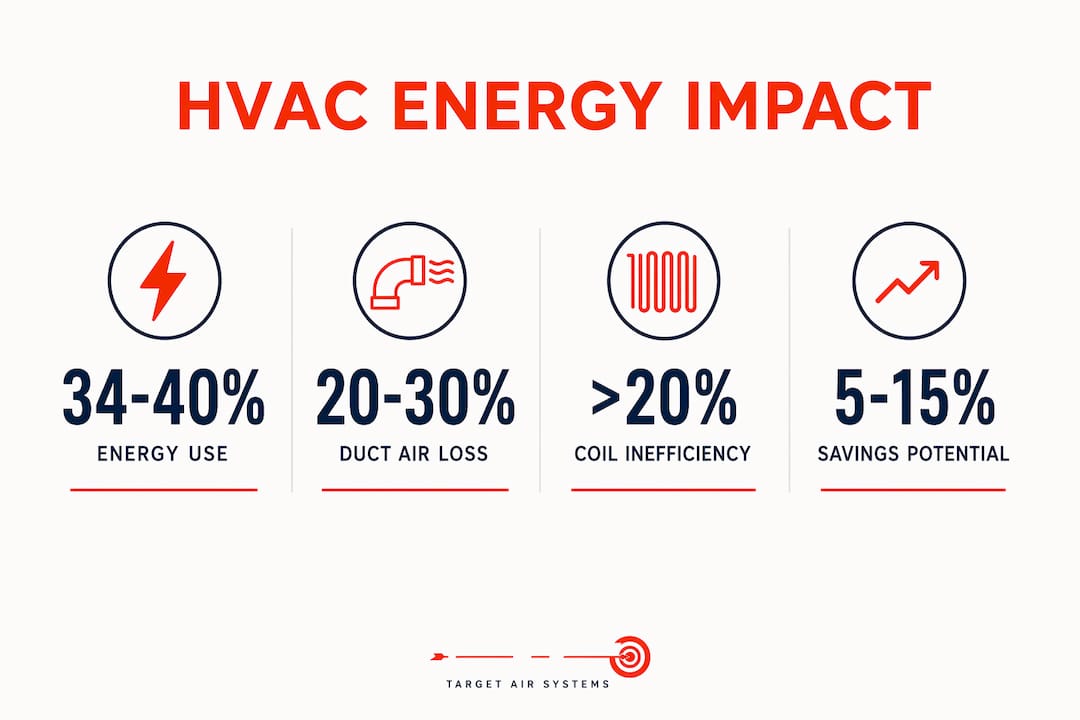
Dirty coils are equally damaging. Fouled coils increase energy consumption by over 20% because heat transfer efficiency drops sharply when coil surfaces are coated with dust and debris. Calendar-based coil cleaning schedules often miss the problem in high-fouling environments like kitchens or manufacturing spaces. Condition-based cleaning, triggered by measured performance decline, is more effective.
Clogged filters and controls drift
Air filters restrict airflow as they load up with particulates. Replacing filters on a fixed calendar schedule sounds disciplined, but it misses the real signal. Monitoring filter pressure differential and replacing at a 1.0 inch w.g. threshold prevents the energy waste caused by excessive static pressure. A clogged filter forces the fan to work harder, consuming more electricity for the same airflow.
Controls drift is a subtler problem. Thermostats get adjusted by occupants. Schedules get overridden during a busy week and never reset. Sensor calibration drifts over time. These small changes accumulate. Commercial buildings routinely operate 20–40% worse than their original design intent because of this operational drift. That gap represents real money leaving your business every month.
Pro Tip: Walk your building once a quarter and note any thermostat overrides or manual damper adjustments. Resetting these to design setpoints costs nothing and often produces immediate savings.
How does energy management reduce HVAC operating costs?
Active energy management is what separates buildings that control their HVAC costs from those that simply pay whatever the utility bill says. The most effective tool in this category is Fault Detection and Diagnostics, commonly called FDD.
FDD programs cost $0.15–$0.45 per square foot annually and reduce HVAC energy use by 5–15%, with a typical return on investment in 1–3 years. FDD software continuously monitors equipment performance data and flags anomalies before they become failures or chronic energy drains. A compressor running slightly outside its normal operating range, for example, gets flagged for inspection rather than running inefficiently for months undetected.
Four management practices deliver the most consistent results:
- Align Building Management System schedules with real occupancy. BMS schedule misalignment with actual occupancy is a major and frequently overlooked cause of energy waste. A system conditioned to start at 6:00 AM for a building that fills at 8:30 AM wastes 2.5 hours of full-load operation every day.
- Track key performance indicators. Monitor energy use intensity (EUI), runtime hours, and supply air temperatures weekly. Trends reveal drift before it becomes expensive.
- Use retrocommissioning every 5–10 years. Retrocommissioning resets HVAC system baselines to address accumulated operational drift and restore the system to its original design performance.
- Manage peak demand actively. Demand charges represent 30–50% of total commercial energy bills. Staggering HVAC startup times and pre-cooling during off-peak hours reduces peak demand and cuts the demand charge portion of your bill.
Pro Tip: Pull your last 12 utility bills and calculate your average demand charge as a percentage of total cost. If it exceeds 35%, demand management should be your first priority.
What HVAC system type has the lowest lifecycle energy cost?
The upfront cost of an HVAC system is rarely its true cost. Lifecycle cost analysis over 20–30 years consistently favors higher-efficiency systems despite their greater initial price, because energy savings and reduced maintenance expenses outweigh the premium over the building’s life.
Two system types dominate commercial building decisions, and each has a different energy cost profile:
| System type | Best fit | Energy cost profile |
|---|---|---|
| Variable Refrigerant Flow (VRF) | Smaller buildings, multi-zone control | Lower operating costs, precise zone control reduces waste |
| Chilled water system | Larger buildings, high redundancy needs | Higher upfront cost, efficient at scale, lower cost per ton |
ASHRAE experts note that a poorly matched system can cost over $2.00 per square foot more annually than a well-selected and well-controlled system. On a 20,000-square-foot building, that is $40,000 in avoidable annual energy costs. The system selection decision made at installation echoes through decades of utility bills.
Lifecycle cost analysis, which accounts for net present value of future energy and maintenance expenses, is the correct framework for this decision. A system that costs $30,000 more upfront but saves $8,000 per year pays back in under four years and delivers compounding savings for the remaining 15–25 years of its service life.
What practical steps reduce HVAC-driven energy costs?
Reducing HVAC energy costs does not require a full system replacement. Most facilities have significant savings available through better operations and targeted maintenance. The HVAC maintenance checklist approach, applied consistently, captures the majority of these gains.
- Switch to condition-based maintenance triggers. Replace filters at the 1.0 inch w.g. pressure differential threshold, not on a calendar. Clean coils when performance data shows degradation, not on a fixed annual schedule.
- Audit ductwork for leaks. Prioritize sections serving high-use zones. Duct sealing typically pays back within one to two years through reduced runtime.
- Align controls with occupancy. Review BMS schedules quarterly. Aligning HVAC scheduling with actual occupancy eliminates the most common source of wasted runtime.
- Benchmark against peers. The U.S. Department of Energy’s ENERGY STAR Portfolio Manager tool lets you compare your building’s energy use intensity against similar buildings nationally. A score below 50 signals significant room for improvement.
- Plan retrocommissioning. If your building has not had a full controls and systems recommissioning in the past five years, schedule one. The HVAC commissioning process resets baselines and often uncovers years of accumulated inefficiency.
Pro Tip: Start with an energy audit before committing to any capital upgrade. Audits routinely identify $5,000–$20,000 in annual savings from operational changes alone, with zero equipment cost.
Key Takeaways
HVAC systems are the largest controllable energy expense in commercial buildings, and operational discipline consistently delivers greater savings than equipment upgrades alone.
| Point | Details |
|---|---|
| HVAC dominates energy bills | HVAC accounts for 34–44% of commercial building energy, making it the top cost driver. |
| Inefficiencies compound costs | Duct leaks and dirty coils can add 15–30% to energy consumption above a well-maintained baseline. |
| Operational drift is hidden waste | Buildings run 20–40% worse than design intent without active monitoring and controls management. |
| Lifecycle cost beats sticker price | A higher-efficiency system saves over $2.00 per square foot annually versus a poorly matched one. |
| Management beats replacement | FDD programs, BMS alignment, and retrocommissioning deliver 5–15% savings with short payback periods. |
The cost you control more than you think
Most facility managers I talk to treat HVAC energy as a fixed overhead, like property taxes. You pay it, you budget for it, and you move on. That framing is expensive.
HVAC energy is a variable cost that responds directly to how well you manage the system. The 20–40% operational drift gap is not a design flaw or an equipment failure. It is the accumulated result of small decisions: a thermostat bumped up by an employee, a schedule never reset after a holiday shutdown, a coil cleaning skipped because the building “seemed fine.” Each one is minor. Together, they add up to a significant and avoidable expense.
The facilities I have seen achieve the best results share one habit: they treat HVAC performance data the way a CFO treats financial data. They review it regularly, they act on anomalies quickly, and they hold the system accountable to a standard. That discipline, more than any single equipment upgrade, is what produces sustainable savings year after year. Combining it with the right equipment choices and periodic retrocommissioning is what separates buildings that manage energy costs from buildings that simply absorb them.
— Warren
How Target Air Systems can help cut your energy costs
Target Air Systems works with business owners and facility managers across the greater Boston area to reduce HVAC-driven energy expenses through maintenance, system upgrades, and controls optimization. Every technician is screened and certified, and you pay nothing until the work is complete. Whether your building needs a commercial HVAC tune-up to address deferred maintenance or a full system assessment to identify lifecycle cost savings, Target Air Systems provides upfront pricing with no hidden fees. Businesses in Framingham, Canton, and surrounding communities can request a service quote and get a clear picture of what it costs to bring their HVAC performance back to design intent.
FAQ
What percentage of a commercial energy bill comes from HVAC?
HVAC systems account for 34–40% of total energy consumption in most commercial buildings, rising to 44% in healthcare facilities. That makes HVAC the single largest line item in a commercial energy budget.
How much energy does a dirty HVAC coil waste?
Fouled coils increase energy consumption by over 20% compared to clean coils. Condition-based cleaning, triggered by measured performance decline rather than a fixed schedule, prevents this waste most effectively.
What is operational drift in HVAC systems?
Operational drift is the gradual gap between a system’s design performance and its actual performance, caused by controls adjustments, occupant overrides, and sensor calibration errors. Commercial buildings typically operate 20–40% worse than design intent because of it.
How quickly does Fault Detection and Diagnostics pay back?
FDD programs typically return their investment in 1–3 years while reducing HVAC energy use by 5–15%. Annual program costs run $0.15–$0.45 per square foot, making them cost-effective for most commercial buildings.
Does HVAC system type affect long-term energy costs?
Yes. Lifecycle cost analysis over 20–30 years shows that a poorly matched HVAC system can cost over $2.00 per square foot more annually than a well-selected system. System type, sizing, and controls quality all determine long-term operating expenses.