


Commercial cooling system repair is the process of diagnosing and fixing faults in HVAC equipment used in offices, retail spaces, industrial facilities, and multi-unit buildings. Facility managers and business owners who understand the types of commercial cooling system repairs can budget accurately, reduce downtime, and avoid the costly mistake of replacing equipment that only needed a targeted fix. Commercial systems include rooftop units, chillers, cooling towers, and building automation systems, and each carries its own repair profile. Knowing which repair type you are dealing with determines who you call, how fast you need to act, and what it will cost.
1. What are the common types of commercial cooling system repairs?
Commercial HVAC repair types fall into four main categories: electrical, mechanical, control system, and maintenance-related. Each category carries different cost ranges, urgency levels, and technician skill requirements.
Electrical repairs
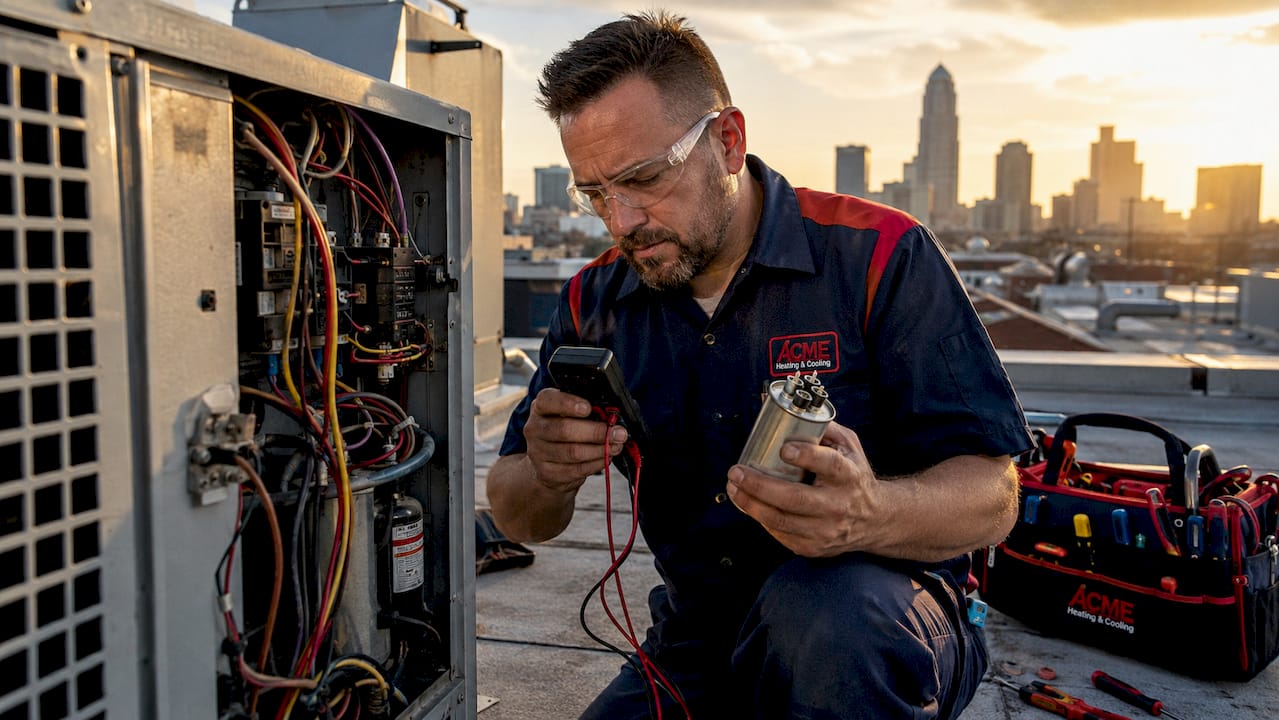
Electrical repairs are the most frequent and lowest-cost category. Capacitor and contactor replacements cost between $250 and $500 per visit. These components fail regularly due to voltage spikes and heat cycles. Catching them early prevents the compressor from burning out, which is a far more expensive problem.
Mechanical repairs
Mechanical repairs cover the physical components that move refrigerant and air. Condenser fan motor repairs run $600 to $1,400, while compressor replacements reach $3,500 to $7,500 depending on unit size. Refrigerant leak repair is one of the most urgent mechanical jobs. Refrigerant leaks cause units to run inefficiently and can lead to permanent compressor damage if left unaddressed for more than a few months.
Control system and BAS repairs
Building automation system (BAS) repairs are the most technically complex category. BAS technicians must be cross-trained in HVAC mechanics and IT networking to avoid costly damage to control boards and software logic. A misconfigured control board can cause an entire zone to lose cooling without triggering an obvious mechanical fault. These repairs require specialized contractors, not general HVAC technicians.
Maintenance-related repairs
Maintenance-related repairs include coil cleaning, belt replacement, condensate drain clearing, and filter replacement. These are low-cost tasks that prevent expensive failures. Skipping coil cleaning, for example, forces the compressor to work harder and shortens its life significantly.
Pro Tip: Schedule a coil inspection every spring before the first heat wave. A dirty condenser coil can raise energy consumption and accelerate compressor wear before you notice any temperature change inside the building.
2. How to decide between repair or replacement for commercial cooling components
The repair-versus-replacement decision is one of the most consequential calls a facility manager makes. Getting it wrong in either direction wastes money.
- Isolate the fault first. A single failed capacitor on a 4-year-old rooftop unit is a clear repair case. Repair is prioritized when the fault is isolated and the asset is not near the end of its useful life.
- Check for recurring failures. If the same component fails twice within 12 months, the root cause is likely systemic, not incidental. Replacement becomes the better financial decision.
- Assess system age. Most commercial rooftop units have a useful life of 15–20 years. A unit past that threshold with a major mechanical fault is almost always a replacement candidate.
- Compare total costs. A compressor replacement at $7,500 on a 17-year-old chiller may cost more than a new unit when you factor in installation, energy savings, and reduced future repair frequency.
- Factor in energy efficiency. Older systems running on R-22 refrigerant or outdated controls consume significantly more energy than current models. The energy savings from replacement can offset the capital cost within a few years.
- Consider safety. A system with degraded electrical components or refrigerant leaks poses liability risks. Replacement removes that exposure entirely.
Replacement is recommended when failures are recurring or energy efficiency has degraded substantially. That guidance applies whether you manage a single retail location or a portfolio of office buildings.
3. What are the standard preventive maintenance options that reduce the need for repairs?
Preventive maintenance is the most cost-effective cooling system maintenance option available to facility managers. A consistent maintenance schedule cuts emergency repair frequency and extends equipment life.
Standard biannual schedule:
- Spring service: Inspect and clean condenser coils, check refrigerant charge, test electrical connections, verify controls, and lubricate moving parts before cooling season begins.
- Fall service: Inspect heating components, check belts and bearings, clear condensate drains, and replace filters ahead of the heating season.
Preventive maintenance contracts typically cost $150 to $300 annually and include priority scheduling for emergency repairs. That cost is a fraction of a single compressor replacement. Most contracts also lock in service call rates, which typically run $75 to $200 per hour.
Scheduling professional servicing before the first heat wave is the single most effective way to avoid a midsummer breakdown. Technicians inspect coils, refrigerant charge, electrical connections, and controls during that visit.
Between professional visits, facility managers can handle basic upkeep themselves. Check and replace air filters monthly in high-use buildings. Keep the area around outdoor condenser units clear of debris. Report any unusual sounds or odors to your HVAC contractor immediately.
Pro Tip: Ask your maintenance contractor to provide a written report after every visit. That documentation becomes your evidence base when deciding whether to repair or replace a unit, and it protects you if a warranty dispute arises.
Scheduling repairs around business hours also matters. Coordinating HVAC service outside peak occupancy hours reduces disruption to staff and customers while giving technicians better access to mechanical rooms and rooftop equipment.
4. Repair types compared: costs, complexity, and downtime impact
| Repair Type | Estimated Cost | Complexity | Downtime Impact | Technician Required |
|---|---|---|---|---|
| Capacitor/contactor replacement | $250–$500 | Low | Minimal | General HVAC tech |
| Condenser fan motor repair | $600–$1,400 | Medium | Moderate | General HVAC tech |
| Refrigerant leak repair and recharge | $1,200–$3,500 | Medium | Moderate to high | EPA-certified tech |
| Compressor replacement | $3,500–$7,500 | High | Significant | Senior HVAC tech |
| BAS/control board repair | Varies | Very high | Potentially zone-wide | Cross-trained HVAC/IT tech |
| Coil cleaning and drain clearing | $150–$400 | Low | None | General HVAC tech |
| Blower motor replacement | $600–$1,200 | Medium | Moderate | General HVAC tech |
Cost data reflects typical commercial unit sizes and current labor rates. Larger chillers and complex multi-zone systems will fall at the higher end of each range. Technician specialization is crucial. Different expertise is required for chillers, rooftop units, and building automation systems, and sending the wrong technician wastes time and risks further damage.
5. What repair options work best for different commercial facility types?
The right repair strategy depends on how your building is used, its size, and the type of cooling system installed.
- Office buildings with rooftop units: Prioritize electrical and refrigerant repairs quickly. A failed rooftop unit in a multi-story office affects entire floors. Maintain a service contract that guarantees a response time of 24 hours or less.
- Retail spaces: Comfort directly affects customer dwell time and sales. Fan motor and refrigerant repairs should be treated as urgent. Consider a backup portable cooling unit for high-revenue periods like summer weekends.
- Industrial and warehouse facilities: These buildings often tolerate higher temperatures, but equipment cooling for servers or production lines cannot. Identify which zones are critical and prioritize repairs there first.
- Multi-zone and ductless heat pump systems: Heat pump repairs require technicians familiar with variable refrigerant flow systems. A fault in one indoor unit does not always indicate a system-wide problem, so accurate diagnosis matters before ordering parts.
- Multi-location portfolios: Treat repairs as asset management rather than isolated incidents. Managing repairs as a portfolio helps identify systemic issues such as poor installation or bad power quality across multiple sites, which improves budgeting and uptime across the board.
- Buildings with BAS integration: Never send a standard HVAC technician to a BAS fault. The repair requires someone who understands both the mechanical system and the network architecture controlling it.
For any facility type, upfront repair pricing before work begins protects your budget and prevents surprise invoices after the job is done.
Key takeaways
Effective commercial cooling repair management requires matching the right repair type to the right technician, cost range, and urgency level before the fault escalates.
| Point | Details |
|---|---|
| Electrical repairs are most common | Capacitor and contactor replacements cost $250–$500 and prevent larger failures. |
| Refrigerant leaks demand fast action | Unrepaired leaks cause permanent compressor damage within months. |
| BAS repairs need specialized techs | Cross-trained HVAC and IT technicians are required to avoid control board damage. |
| Preventive contracts save money | Annual contracts at $150–$300 cut emergency repair frequency and lock in labor rates. |
| Repair vs. replacement hinges on recurrence | Isolated faults favor repair; recurring failures or aging systems favor replacement. |
What I have learned managing commercial cooling repairs
The biggest mistake I see facility managers make is treating every repair as a one-off event. A single failed contactor is just a failed contactor. But when three units on the same floor fail within six months, that is a pattern. Treating repairs as portfolio management forces you to ask whether the problem is the equipment or something upstream, like unstable power supply or poor original installation.
The second mistake is delaying refrigerant leak repairs because the system “still works.” It does work, but it works harder every day, and the compressor is absorbing that stress. By the time the compressor fails, you are looking at a $7,500 repair instead of a $1,500 leak fix.
Technician selection matters more than most facility managers realize. Choosing a specialized HVAC contractor rather than a generalist is not about prestige. It is about avoiding the scenario where an unqualified technician misdiagnoses a BAS fault, replaces the wrong component, and leaves you with the same problem and a larger bill. Ask contractors directly whether they have experience with your specific system type before scheduling any work.
Proactive scheduling is the last piece. Emergency repairs always cost more than planned ones, and they always happen at the worst time. A $200 annual maintenance contract that prevents one emergency call pays for itself many times over.
— Warren
Target Air Systems is ready when your cooling system needs attention
Target Air Systems serves facility managers and business owners across the greater Boston area with certified technicians who specialize in commercial cooling system repairs, from capacitor replacements to full compressor jobs. Every visit comes with upfront pricing before any work begins, so you know exactly what you are approving. Target Air Systems offers maintenance contracts that cover biannual inspections, priority emergency scheduling, and detailed service reports after every visit. Whether you manage a single retail location or a multi-building portfolio, the team is equipped to handle the full range of commercial AC repairs without hidden fees or surprises. Request a quote to get a clear estimate for your facility’s repair or maintenance needs.
FAQ
What are the most common types of commercial HVAC repairs?
The most common repairs are capacitor and contactor replacements, refrigerant leak repairs, condenser fan motor replacements, and coil cleaning. Electrical component repairs are the most frequent and typically cost $250–$500 per visit.
How much does commercial cooling system repair cost?
Costs range from $250–$500 for minor electrical repairs to $3,500–$7,500 for compressor replacements. Refrigerant leak repair and recharge on a 5-ton system typically runs $1,200–$3,500.
How often should commercial HVAC systems be serviced?
Commercial cooling systems should be serviced twice per year, once in spring before cooling season and once in fall before heating season. Annual maintenance contracts covering both visits typically cost $150–$300.
When should I repair vs. replace a commercial cooling unit?
Repair is the right choice when the fault is isolated and the unit is not near the end of its useful life. Replacement makes more sense when failures are recurring, the system is past 15–20 years old, or energy efficiency has degraded significantly.
Do BAS repairs require a different type of technician?
Yes. Building automation system repairs require technicians cross-trained in both HVAC mechanics and IT networking. Sending a standard HVAC technician to a BAS fault risks damaging control boards and software logic, which increases repair costs substantially.