


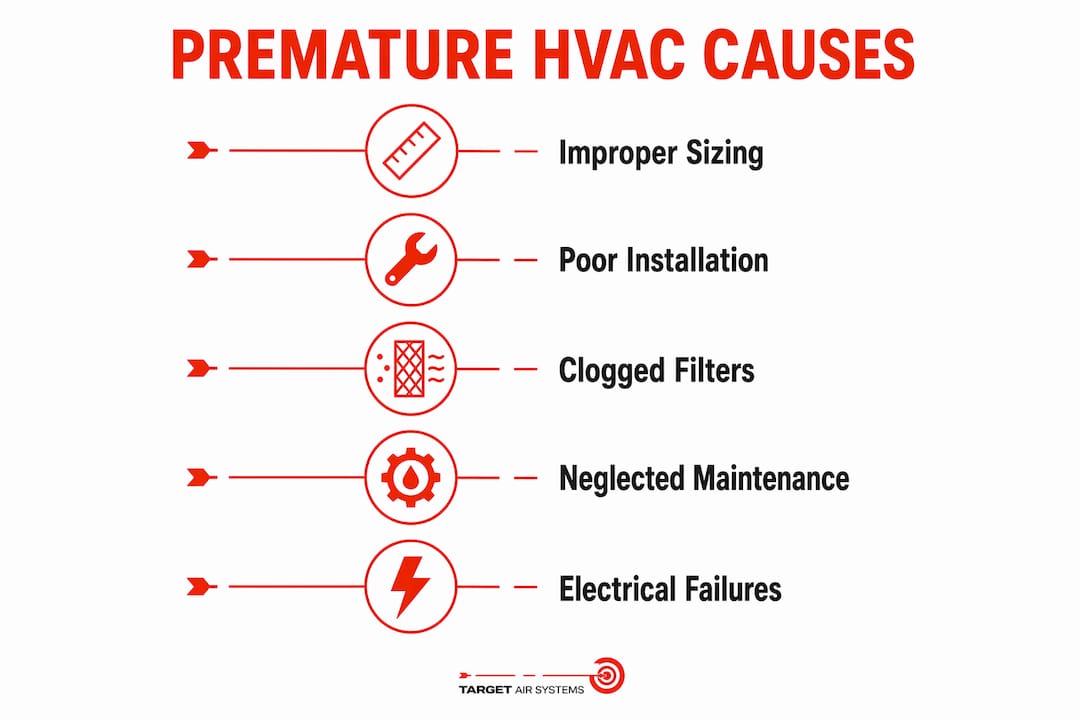
Premature HVAC failure is defined as a system breakdown that occurs well before its expected service life ends, caused primarily by avoidable factors rather than normal aging. Residential air conditioners carry a median service life of 12–15 years, yet 1 in 3 fail early due to neglect and installation errors. The main culprits behind what causes premature HVAC failure are improper system sizing, poor installation, clogged air filters, and skipped maintenance. Each of these problems places unnecessary mechanical stress on components like compressors, blower motors, and heat exchangers. Understanding these causes gives you the power to act before a breakdown happens.
What causes premature HVAC failure: the role of improper sizing
Improper system sizing is one of the most damaging and least discussed causes of early HVAC breakdown. Homeowners often assume bigger is better, but an oversized unit creates a problem called short cycling. Short cycling means the system reaches its temperature target too fast, shuts off, and restarts repeatedly throughout the day.
Each compressor startup draws 5 to 10 times its steady running current. That repeated electrical surge degrades winding insulation and starves the compressor of lubrication before oil pressure stabilizes. Short cycling alone can reduce compressor lifespan by 30–50%. That is a massive reduction in equipment life from a single sizing mistake.
Undersized systems cause a different but equally destructive problem. They run continuously trying to meet demand, which overheats motors and drives up energy bills. Undersized units increase utility costs by 25–30% compared to properly sized equipment. Continuous operation also means the system never gets a recovery period, which accelerates wear on every moving part.
High static pressure compounds both problems. When ductwork is too small or leaky, the blower motor fights against resistance on every cycle. High static pressure forces blower motors to overwork, leading to motor burnout and heat exchanger cracks over time.
Common sizing mistakes that cause early failure include:
- Installing equipment based on square footage alone, ignoring insulation, ceiling height, and window area
- Skipping a Manual J load calculation, which is the industry standard for accurate sizing
- Replacing old equipment with the same size unit without reassessing current home conditions
- Ignoring duct system capacity when selecting new equipment
Pro Tip: Ask your HVAC contractor for a written Manual J load calculation before any installation. If they cannot provide one, that is a red flag worth taking seriously.
How poor installation leads to early HVAC breakdown
Most premature HVAC failures trace back to hidden installation problems that create constant unnecessary strain from day one. A system can be perfectly sized and still fail early if it is installed incorrectly. The damage is often invisible until a major component gives out.
Incorrect refrigerant charging is one of the most common and costly installation errors. Too little refrigerant causes the compressor to run hot and work harder to move heat. Too much refrigerant raises system pressure beyond safe operating limits. Both conditions accelerate compressor wear and reduce cooling efficiency from the first day of operation.
Other installation flaws that cause HVAC system lifespan issues include:
- Sensor misplacement causing the thermostat to read incorrect temperatures and trigger unnecessary cycling
- Electrical connections left loose or undersized, creating resistance heat and fire risk at terminals
- Refrigerant line sets that are too long or improperly insulated, reducing system efficiency
- Incomplete commissioning, meaning the installer never verified airflow, refrigerant levels, or electrical draw after startup
Installation without a full Manual J and commissioning report causes improper refrigerant levels and airflow imbalance that lead directly to premature failures. A commissioning report documents that every system parameter was verified at startup. Without it, you have no proof the system was set up correctly.
Installation errors can also void manufacturer warranties. Most major brands, including Carrier, Lennox, and Trane, require certified installation and documented commissioning to honor their warranty terms. A bad install does not just shorten your system’s life. It can leave you paying full price for repairs that should have been covered.
Pro Tip: Request a copy of the commissioning report after any new HVAC installation. A reputable contractor will provide one without hesitation.
How clogged air filters cause HVAC system breakdowns
Dirty air filters are the most frequent preventable cause of HVAC service calls, accounting for roughly 70% of AC failure calls. That single statistic tells you more about preventing early HVAC failure than almost anything else. A clogged filter is not just a minor inconvenience. It triggers a chain reaction that can destroy major components.
When airflow is restricted, the evaporator coil cannot absorb enough heat from the air passing over it. The coil temperature drops below freezing and ice forms on its surface. A frozen coil blocks airflow completely, forcing the blower motor to work against near-total resistance. That motor stress, sustained over hours or days, leads to burnout.
Watch for these warning signs that your filter is causing system strain:
- Weak or warm airflow from supply vents despite the system running
- Ice visible on the refrigerant lines near the indoor unit
- Unusual humming or straining sounds from the air handler
- Higher-than-normal electricity bills without a change in usage
A frozen evaporator coil caused by a clogged filter can damage the compressor if the system continues running. Turn the system off and let the coil thaw completely before replacing the filter and restarting.
Most homeowners should replace standard 1-inch filters every 30–60 days. Homes with pets, heavy dust, or allergy concerns need changes even more frequently. Thicker media filters, such as 4-inch or 5-inch models, can last up to 6 months but still require regular inspection. A year-round HVAC maintenance checklist helps you track filter changes alongside other seasonal tasks.
Does neglected maintenance shorten HVAC system lifespan?
Neglected maintenance is the fastest way to shorten system life. Well-maintained systems reach the upper limit of their expected lifespan, while neglected systems fail at just 60–70% of that potential. For a system rated to last 15 years, that means failure at 9 or 10 years instead.
Annual tune-ups catch small problems before they become expensive ones. A technician checking refrigerant levels, cleaning coils, tightening electrical connections, and lubricating moving parts prevents the gradual wear that leads to sudden breakdowns. Annual maintenance tune-ups and filter changes are the single most effective strategy for preventing premature HVAC failure.
The repair buildup pattern is another warning sign homeowners miss. Three or more major repairs within three years signals cascading component failure. Each repair fixes one symptom while the underlying stress continues damaging other parts. At that point, continued repair spending is rarely a sound investment compared to replacement.
Key maintenance gaps that accelerate HVAC system lifespan issues include:
- Skipping annual professional tune-ups, allowing refrigerant leaks and coil fouling to go undetected
- Ignoring condensate drain cleaning, which leads to water damage and mold inside the air handler
- Failing to clean outdoor condenser coils, which forces the compressor to work harder in summer heat
- Delaying refrigerant phase-out planning, particularly for older systems still using R-22, which is no longer manufactured and now extremely expensive to source
Stat to know: Homeowners who skip annual maintenance pay significantly more in emergency repair costs over a system’s life than those who invest in regular tune-ups.
What electrical and mechanical failures signal premature HVAC breakdown?
Electrical component failures are a direct consequence of the sizing, installation, and maintenance problems described above. Capacitors and contactors wear out faster in systems that short cycle, because each startup event places a surge load on these components. A failed capacitor prevents the compressor or fan motor from starting, which is one of the most common summer service calls.
Compressor motor insulation breaks down when the winding temperature exceeds design limits. Short cycling causes this by forcing the compressor to restart before it has cooled and before oil pressure has stabilized. Compressor startup current runs 5 to 10 times the steady running current. Repeated high-current startups without adequate lubrication degrade winding insulation until the motor fails completely.
Blower motor burnout follows a similar pattern. High static pressure from undersized or leaky ductwork forces the motor to draw excess current on every cycle. Over months, that excess heat destroys the motor windings. Heat exchanger cracks are another consequence of high static pressure, and they carry a safety risk because cracked heat exchangers can allow combustion gases to enter living spaces.
Early warning signs of electrical and mechanical failure:
- Hard starts, where the system hesitates or clicks repeatedly before the compressor engages
- Burning or electrical smell near the air handler or outdoor unit
- Tripped breakers that reset but trip again within hours
- Uneven cooling or heating across rooms, which often signals blower motor weakness
Pro Tip: If your system is hard-starting, a hard-start kit can reduce startup current draw and extend compressor life. Ask a certified technician whether your system is a good candidate.
Key takeaways
Premature HVAC failure is caused by improper sizing, poor installation, clogged filters, and neglected maintenance, all of which are preventable with the right approach.
| Point | Details |
|---|---|
| Sizing matters most | Oversized and undersized systems both cause early failure through short cycling or continuous overheating. |
| Installation errors cause day-one damage | Incorrect refrigerant charge and missing commissioning reports create strain from the first startup. |
| Clogged filters trigger chain failures | Restricted airflow freezes coils, overloads blower motors, and accounts for 70% of AC service calls. |
| Maintenance extends system life | Well-maintained systems reach 12–15 years; neglected ones fail at 60–70% of that potential. |
| Repair buildup signals replacement time | Three or more major repairs in three years indicates cascading failure, not isolated bad luck. |
What homeowners consistently get wrong about HVAC failure
After years of working alongside HVAC professionals and talking with homeowners across Massachusetts, one pattern stands out clearly. Homeowners treat their HVAC system like a smoke detector. They ignore it until something goes wrong.
The warning signs are almost always there first. Unusual noises, rooms that stopped cooling evenly, a system that runs longer than it used to. These are not quirks. They are the system telling you a component is under stress. Waiting for total breakdown turns a $300 capacitor replacement into a $3,000 compressor job.
The second mistake I see constantly is trusting installation quality without verifying it. A low bid often means a skipped Manual J calculation and no commissioning report. The system gets installed, it runs, and the homeowner assumes everything is fine. The damage from an incorrect refrigerant charge or a misplaced sensor shows up 18 months later as a failed compressor, and by then the installer is long gone.
My honest advice: treat your HVAC system like your car. You would not skip oil changes and then wonder why the engine seized. Schedule a professional tune-up every year, change filters on a set schedule, and get a second opinion before any repair over $500. If you are facing the repair versus replacement decision, look at repair frequency over the past three years, not just the cost of the current fix. The pattern tells you more than any single invoice.
— Warren
How Target Air Systems helps prevent early HVAC failure
Target Air Systems serves homeowners across Natick, Framingham, Canton, and surrounding Massachusetts communities with the kind of installation and maintenance work that actually extends equipment life. Every installation includes proper load calculations and a commissioning report, so your system starts correctly from day one. Certified technicians handle AC maintenance and tune-ups that cover coil cleaning, refrigerant checks, electrical inspections, and filter service. If your system is showing signs of early failure or you want to get ahead of problems before they escalate, Target Air Systems provides upfront pricing with no hidden fees and requires no payment until the job is complete. Get a quote and find out what proper HVAC care looks like for your home.
FAQ
What is the most common cause of premature HVAC failure?
Clogged air filters are the most frequent preventable cause, accounting for roughly 70% of AC service calls. Improper system sizing and poor installation are the leading causes of structural, long-term failure.
How long should a residential HVAC system last?
A well-maintained residential air conditioner has a median service life of 12–15 years. Neglected systems often fail at 60–70% of that potential, meaning breakdowns at 8–10 years instead.
Does short cycling really damage an HVAC compressor?
Short cycling reduces compressor lifespan by 30–50% because each startup draws 5 to 10 times the normal running current. Repeated high-current startups without adequate lubrication degrade motor windings until the compressor fails.
How do I know if my HVAC system was installed correctly?
Ask your installer for a Manual J load calculation and a commissioning report. If neither was provided, have a certified technician inspect refrigerant charge, static pressure, and electrical draw to verify proper setup.
When should I replace rather than repair my HVAC system?
Three or more major repairs within three years signals cascading component failure. At that point, continued repair spending typically costs more over time than investing in a properly sized replacement system.