


Commercial HVAC repair is the specialized process of diagnosing, servicing, and restoring heating, ventilation, and air conditioning systems in commercial buildings to maintain efficient operation and regulatory compliance. The industry term is “commercial HVAC service,” and it covers everything from replacing a failed compressor in a rooftop unit to recalibrating variable air volume (VAV) boxes across a multi-floor office building. Unlike residential work, commercial HVAC repair demands certified technicians, specialized diagnostic tools, and a working knowledge of standards like ASHRAE 62.1, which governs ventilation and indoor air quality in occupied commercial spaces. For business owners and property managers, understanding this discipline is the difference between planned maintenance costs and unplanned operational shutdowns.
What is commercial HVAC repair and how does it differ from residential?
Commercial HVAC repair covers a fundamentally different scope than residential service, starting with the electrical systems involved. Commercial systems operate on 208V/460V three-phase power, compared to the standard 120V/240V single-phase circuits in homes. That voltage difference alone requires technicians with specific electrical certifications that most residential contractors simply do not hold.
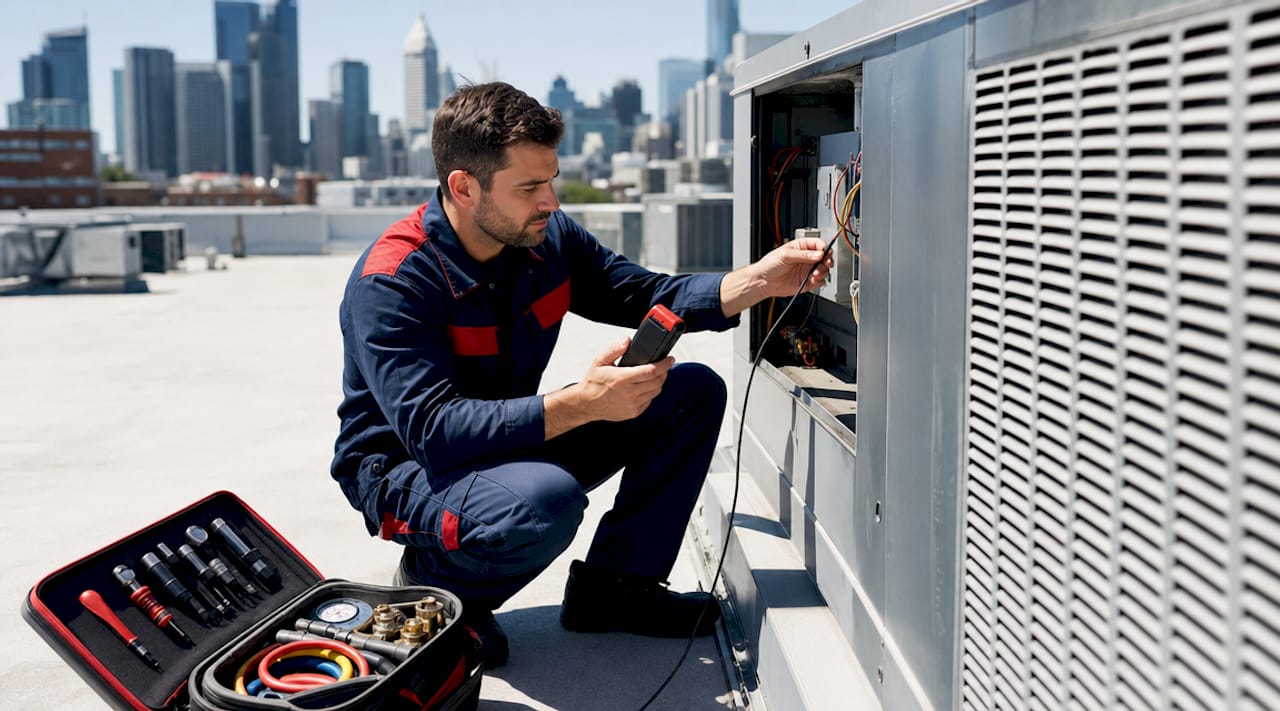
The equipment scale compounds this complexity. A commercial building may run chillers, cooling towers, air handling units, VAV boxes, economizers, and building automation systems (BAS) simultaneously. Each component requires vendor-specific training to diagnose accurately. VAV boxes and building automation networks, for example, need proprietary diagnostic software and calibrated test equipment that a residential technician would never carry on a service van.
Here is what sets commercial HVAC repair apart in practical terms:
- Scale and redundancy: Commercial systems are designed to serve hundreds of occupants across multiple zones, often with redundant components to prevent full shutdowns.
- Regulatory compliance: Systems must meet ASHRAE 62.1 ventilation standards, local mechanical codes, and in some cases EPA Section 608 refrigerant handling requirements.
- Specialized components: Chillers, rooftop units (RTUs), economizers, and VAV boxes each require distinct repair procedures and tools.
- Technician certification: EPA 608 Universal certification is the baseline; many commercial jobs require additional manufacturer training for specific BAS platforms.
- Operational impact: A failed residential system inconveniences a family. A failed commercial system can trigger tenant liability, lost revenue, and health code violations within hours.
The bottom line is that sending a residential contractor to a commercial job site is not just inefficient. It is a compliance and liability risk.
Common commercial HVAC repair services and their costs
The most frequent commercial HVAC repair services fall into three categories: mechanical failures, refrigerant issues, and control system faults. Compressor replacement is the most expensive single repair, often running well into five figures on large tonnage equipment. Motor and belt replacements are more routine and typically resolved within a single visit. Refrigerant leak detection and recharge require EPA-certified technicians and can range from straightforward to complex depending on system age and refrigerant type.
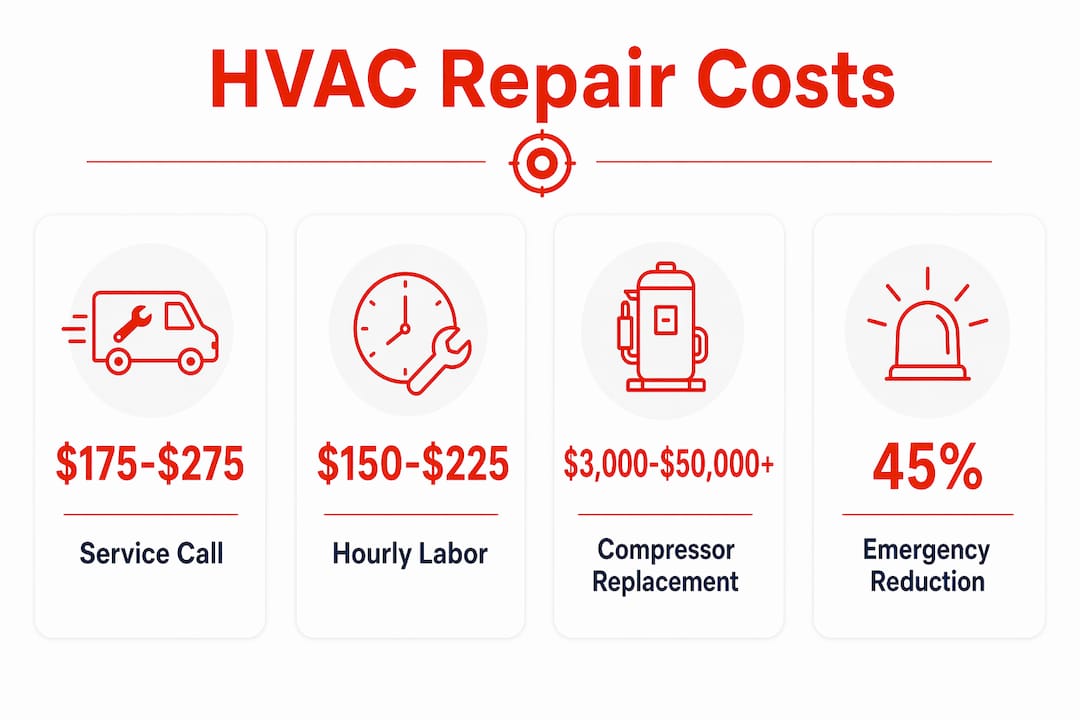
Pricing follows a predictable structure. Standard daytime service calls cost $175 to $275, with diagnostic labor billed at $150 to $225 per hour. That baseline matters because it sets the floor for every repair conversation you will have with a contractor. Emergency after-hours calls multiply those rates by 1.5 to 3 times, which is why a $200 daytime repair can become a $600 midnight call for the same work.
| Repair Type | Typical Cost Range | Notes |
|---|---|---|
| Compressor replacement | $3,000 to $50,000+ | Depends on unit tonnage and refrigerant type |
| Refrigerant leak repair | $500 to $2,500 | Includes leak detection, repair, and recharge |
| Motor or belt replacement | $300 to $1,200 | Usually completed in one visit |
| VAV box recalibration | $200 to $800 per zone | Requires BAS access and specialized tools |
| Annual maintenance contract | $500 to $5,000 | Varies by system complexity and coverage level |
Scheduling also affects total cost in ways that rarely appear on invoices. Most commercial HVAC repairs complete within one business day when scheduled in advance. Emergency repairs, by contrast, can disrupt operations for multiple days, particularly when parts must be expedited. Reactive maintenance accounts for 84% of emergency repair budgets globally, which means the majority of emergency spending is preventable.
Pro Tip: Before any service visit, prepare a mechanical room access log, roof access instructions, and a current equipment list with model and serial numbers. Technicians who arrive with this information resolve issues faster, and faster resolution means lower labor costs for you.
Why preventive maintenance is critical in commercial HVAC systems
Preventive maintenance is not a cost center. It is a risk management tool. Organizations that run structured preventive maintenance programs with at least 80% compliance see 45% fewer emergency callouts and reduce total HVAC spend by 18 to 24% within 12 months. That reduction comes from catching failures early, not from doing more work.
A well-maintained commercial HVAC system also consumes 15 to 25% less energy and extends equipment life by 30 to 40%. For a building running a 200-ton chiller, that lifespan extension translates directly into deferred capital expenditure of hundreds of thousands of dollars.
A standard preventive maintenance program for a commercial building includes:
- Filter inspection and replacement based on pressure differential readings, not fixed calendar schedules. Pre-filters should be inspected monthly and replaced when pressure drop exceeds 0.5 inches water gauge. Final filters typically last three to six months.
- Coil cleaning to maintain heat transfer efficiency. Dirty evaporator and condenser coils force compressors to work harder, accelerating wear.
- Electrical connection checks including torque verification on terminals, which prevents arc faults and motor failures.
- Condensate drain clearing to prevent water damage and mold growth, particularly relevant in humid climates.
- Refrigerant level verification to catch slow leaks before they cause compressor damage.
- BAS setpoint review to confirm control sequences match current occupancy schedules and seasonal conditions.
The distinction between preventive and predictive maintenance is worth understanding. Preventive maintenance follows a schedule. Predictive maintenance uses real-time sensor data, runtime hours, and vibration analysis to trigger service only when measurements indicate an impending failure.
“Treating HVAC maintenance as a paperwork exercise rather than a live-data driven process is one of the most common mistakes in facilities management. Real-time pressure and runtime measurements improve maintenance effectiveness far beyond what any fixed schedule can achieve.” — Effective commercial HVAC preventive maintenance practices
Customized maintenance plans tailored to your specific equipment, duty cycles, and local regulatory requirements consistently outperform generic plans. A restaurant kitchen with 16-hour daily HVAC runtime needs a fundamentally different maintenance cadence than a medical office running standard business hours.
How to select the best commercial HVAC repair service plans
Choosing a service agreement is a financial decision, not just a facilities decision. The wrong contract leaves you exposed to costs that dwarf the premium you saved. Reactive repairs cost 4 to 8 times more than planned preventive maintenance when you factor in emergency labor rates, expedited parts, and business downtime. That multiplier is the core argument for any service agreement.
Commercial HVAC service contracts fall into three tiers:
| Contract Type | What’s Covered | Best For |
|---|---|---|
| Preventive maintenance only | Scheduled inspections and tune-ups | Low-risk facilities with newer equipment |
| Parts and labor agreement | Repairs plus maintenance, fixed labor rates | Mid-age equipment, moderate downtime risk |
| Full-coverage plan | All labor, parts, maintenance, and emergency response | Mission-critical facilities, older equipment |
Full-coverage service contracts shift financial risk to the contractor and are strongly recommended where HVAC downtime carries significant revenue risk. A hotel, hospital, or data center cannot afford to negotiate parts pricing during a system failure at 2 a.m. A fixed-price contract eliminates that negotiation entirely.
When evaluating providers, ask these four questions directly:
- Does the contract cover emergency response, and what is the guaranteed response time?
- Are parts included at cost or marked up, and is there a cap on parts expenditure?
- Is the plan customized to your specific equipment list, or is it a generic template?
- What certifications do the assigned technicians hold, and are they manufacturer-trained on your BAS platform?
Pro Tip: Request a sample service report from any provider before signing. A contractor who cannot show you what a completed maintenance report looks like is almost certainly not collecting the pressure differential and runtime data that makes preventive maintenance effective.
For property managers overseeing HVAC services in Framingham or surrounding communities, local providers with rapid response capabilities reduce the window between failure and resolution, which directly limits operational disruption.
Key takeaways
Commercial HVAC repair requires certified technicians, customized service plans, and a shift from reactive to preventive maintenance to protect both equipment and business continuity.
| Point | Details |
|---|---|
| Commercial vs. residential scope | Commercial systems use 208V/460V three-phase power and require EPA-certified, manufacturer-trained technicians. |
| Cost structure | Daytime service calls run $175 to $275; emergency rates are 1.5 to 3 times higher, making scheduling critical. |
| Preventive maintenance ROI | Structured PM programs reduce emergency callouts by 45% and cut total HVAC spend by 18 to 24% within 12 months. |
| Service plan selection | Full-coverage contracts shift financial risk to contractors and are recommended for mission-critical facilities. |
| Filter replacement standard | Replace filters based on pressure differential readings, not fixed schedules, to optimize performance and cost. |
What I’ve learned about commercial HVAC repair after years in the field
Most property managers I talk to underestimate one thing: how much the quality of site documentation affects repair outcomes. Technicians who arrive at a building with a current equipment list, accurate floor plans showing mechanical room locations, and a clear roof access protocol resolve issues measurably faster than those who spend the first hour figuring out where the air handling units are. That preparation costs you nothing and saves real money on labor.
The second thing I push back on consistently is the idea that any service contract is better than none. Generic maintenance agreements that apply the same inspection checklist to a 10-ton rooftop unit and a 200-ton chiller are not protecting you. They are creating the appearance of protection. I have seen buildings with active maintenance contracts experience catastrophic compressor failures that a pressure trend analysis would have flagged three months earlier. The contract existed. The data collection did not.
My honest recommendation is to treat your HVAC service agreement the way you treat your property insurance. You do not buy the cheapest policy available and assume you are covered. You read what is actually included, verify the response commitments are real, and confirm the technicians assigned to your account are qualified for your specific equipment. The hidden costs of reactive repair including lost revenue, tenant liability, and expedited parts can multiply your direct repair bill by four to eight times. No service contract premium comes close to that exposure.
— Rich
How Targetairsystems supports your commercial HVAC needs
Targetairsystems brings certified technicians, upfront pricing, and no-payment-until-completion service to commercial property owners and managers across the greater Boston area. Whether you need emergency repair, a scheduled AC maintenance tune-up, or a full-coverage service agreement tailored to your equipment list, the team at Targetairsystems delivers without hidden fees or surprise invoices. Their Canton HVAC services and surrounding coverage areas mean rapid response when system failures cannot wait. With 5-star reviews and a long-standing community presence, Targetairsystems is the local partner that business owners and property managers in Natick, MA and nearby communities rely on to keep systems running year-round.
FAQ
What does commercial HVAC repair include?
Commercial HVAC repair covers diagnosing and fixing heating, cooling, and ventilation systems in commercial buildings, including compressors, VAV boxes, rooftop units, chillers, and building automation controls. It also includes refrigerant leak repair, motor replacements, and electrical system servicing.
How much does a commercial HVAC service call cost?
Standard daytime service calls run $175 to $275, with labor billed at $150 to $225 per hour. Emergency after-hours rates are 1.5 to 3 times higher, and major repairs such as compressor replacement can exceed $50,000.
How often should commercial HVAC systems be serviced?
Commercial HVAC systems should receive preventive maintenance at least twice per year, with filter inspections monthly and replacement triggered by pressure differential readings rather than fixed schedules.
What are the benefits of a commercial HVAC maintenance plan?
Structured preventive maintenance programs reduce emergency callouts by 45% and lower total HVAC spend by 18 to 24% within 12 months, while also extending equipment lifespan by 30 to 40%.
Can a residential HVAC contractor work on commercial systems?
Residential contractors generally lack the certifications, specialized tools, and manufacturer training required for commercial HVAC systems. Commercial work requires EPA 608 Universal certification and often vendor-specific training for building automation platforms.