


Upfront HVAC repair pricing is a fixed, transparent cost estimate delivered to you before any technician touches your system. Known in the industry as flat-rate pricing, this model tells you exactly what a repair costs, covering parts, labor, and fees, with no hourly meter running in the background. Getting upfront HVAC repair pricing protects you from surprise invoices and gives you the power to approve or decline work on your own terms. 82% of US residential HVAC firms now use flat-rate pricing as their primary billing method, which means most contractors you call in 2026 already operate this way. Knowing how the system works puts you in control of every conversation.
How to get upfront HVAC repair pricing from any contractor
Flat-rate pricing means the contractor quotes you one number for a defined job before work begins. That number covers the technician’s time, the parts, overhead, and the company’s warranty reserve. You agree to the price, then the work starts. No surprises when the invoice arrives.
The first step is requesting an itemized written estimate that separates parts cost, labor cost, and any service or diagnostic fees. Most contractors using digital price books, such as ServiceTitan or Housecall Pro, can generate this on a tablet at your door. If a technician quotes you verbally and resists putting it in writing, that is a warning sign worth taking seriously.

Diagnostic fees are the one cost you will typically pay before seeing a full repair quote. Diagnostic fees range from $89 to $159 and are often waived if you accept the repair. Paying the diagnostic fee is still worth it in most cases because it prevents a technician from rushing through an assessment to avoid a low bill. A thorough diagnosis leads to an accurate quote.
Here is a practical checklist for getting a clear estimate every time:
- Ask the dispatcher when booking whether the company uses flat-rate or hourly pricing
- Request that all fees, including the diagnostic charge, be disclosed before the appointment
- Ask for the quote in writing or as a digital document sent to your email
- Photograph the broken component before the technician arrives so you have a reference point
- Verify the technician’s license number through your state contractor board before authorizing work
- Ask specifically whether the quoted price includes a labor warranty and for how long
Pro Tip: Digital price books used by field service management software make upfront pricing more accurate and consistent. Ask your contractor which pricing tool they use. Companies using structured price books are far less likely to quote inconsistently between technicians.
Flat-rate vs. hourly pricing: what the difference costs you
Flat-rate pricing and hourly pricing produce very different outcomes for homeowners, and understanding the gap matters before you approve any repair.
With hourly pricing, you pay for every minute a technician spends on your job. A slow worker, an unexpected parts run, or a complicated diagnosis all add to your bill. Hourly pricing incentivizes slower work, and emergency calls under this model can cost 50 to 100% more than standard rates. The uncertainty alone is a problem. 92% of homeowners prefer knowing the total cost upfront, which explains why the industry has moved so decisively toward flat-rate models.
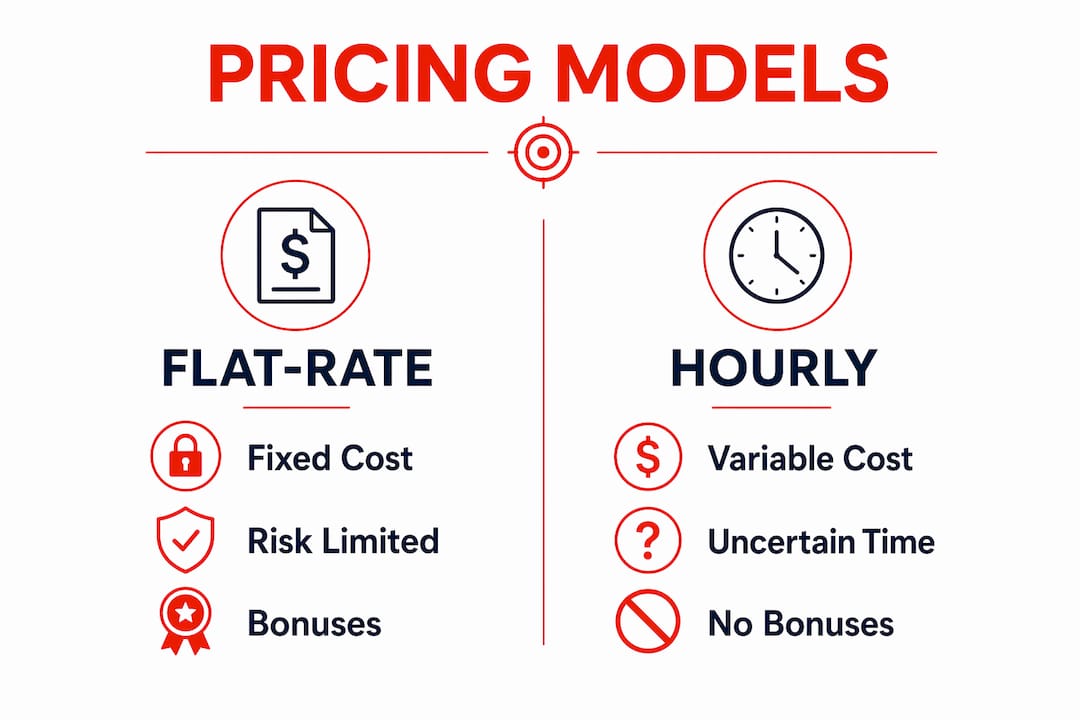
Flat-rate pricing solves the uncertainty problem but introduces its own trade-off. The fixed price includes built-in labor padding to account for jobs that take longer than expected. A capacitor replacement that takes 15 minutes may be priced as 1.5 hours of labor in the flat-rate book. On a quick job, you pay more than the raw time cost. On a complicated job, you pay less. Over time, the pricing averages out, but on any single repair, the math may not favor you.
| Pricing model | How you’re billed | Risk to homeowner | Best for |
|---|---|---|---|
| Flat-rate | Fixed price per defined job | Overpaying on fast repairs | Predictability and budget control |
| Hourly | Time plus materials | Open-ended cost, slow work risk | Simple, fast jobs with trusted contractors |
| Hybrid | Flat diagnostic, hourly repair | Partial uncertainty remains | Uncommon; evaluate case by case |
The flat-rate model also shifts contractor culture in your favor. Technicians earn bonuses for efficiency and quality, not for logging hours. That means a skilled technician has every incentive to fix your system correctly and quickly, rather than stretching the job.
How to negotiate and reduce your HVAC repair quote
Flat-rate quotes are not final offers. 30 to 40% of flat-rate quotes are negotiated down when homeowners push back with competing quotes or ask specific questions. Most homeowners never try, which is exactly why contractors rarely volunteer discounts.
The most effective negotiation approach follows three steps. First, get at least two written quotes for the same repair. Price variance on identical repairs often exceeds 40%, meaning a $1,500 quote from one contractor may be $900 from another for the exact same job. Second, present the lower quote to your preferred contractor and ask if they can match or beat it. Third, ask the technician to separate optional add-ons from the core repair so you can decline services you do not need right now.
One tactic most homeowners overlook: technicians often have limited authority to approve discounts on their own. Office managers can approve price reductions that field technicians cannot. If the technician says the price is fixed, politely ask to speak with the service manager or office before making a decision.
Timing also affects what you pay. Scheduling repairs during shoulder seasons, meaning spring and fall, can reduce costs by 15 to 25% compared to peak summer and winter demand. HVAC companies lower prices and offer promotions when their schedules have open slots.
Pro Tip: Never accept a quote that bundles a maintenance plan or service agreement into a repair price without your explicit request. Unbundling optional services from the core repair quote is one of the fastest ways to reduce what you pay today.
Watch for these warning signs of aggressive pricing:
- The technician quotes a price verbally and cannot produce a written breakdown
- The quote changes after the technician “calls the office” without a clear explanation
- You are pressured to approve the repair immediately or lose a special price
- The diagnostic fee is not disclosed before the appointment
- The quote includes parts you cannot verify are needed based on the diagnosis
Evaluating whether an upfront HVAC repair quote is fair
A written quote is only useful if you know what fair looks like. Common repairs in 2026 fall into predictable price ranges, and knowing those ranges tells you immediately whether a quote deserves a second look.
Capacitor replacement runs $180 to $400, while a blower motor replacement ranges from $650 to $1,400 depending on the motor type and brand. Minor repairs generally fall between $150 and $400. Typical mid-range repairs land between $400 and $1,200. Major repairs or emergency calls start at $1,500 and climb from there.
| Repair type | Typical price range | Key price factors |
|---|---|---|
| Capacitor replacement | $180 to $400 | Part brand, single vs. dual run |
| Blower motor replacement | $650 to $1,400 | Motor type, OEM vs. aftermarket |
| Refrigerant recharge | $200 to $600 | Refrigerant type, leak detection included |
| Thermostat replacement | $150 to $450 | Smart vs. standard, wiring complexity |
| Heat exchanger repair | $1,500 to $3,500 | Severity, furnace age, warranty status |
When a quote lands above the top of a typical range, ask the contractor to explain what drives the higher cost. A legitimate answer will reference specific parts, labor complexity, or warranty terms. A vague answer is a reason to get a second opinion.
Repairs that approach or exceed $2,000 also warrant a conversation about replacement. A furnace or air conditioner more than 15 years old with a repair quote above $1,500 may cost less over five years as a replacement than as a repaired unit. A trustworthy contractor will raise this comparison without being asked.
Key takeaways
Homeowners who request written, itemized flat-rate quotes before authorizing work pay less, dispute less, and choose better contractors than those who accept verbal estimates.
| Point | Details |
|---|---|
| Flat-rate pricing dominates | 82% of US residential HVAC firms use flat-rate billing, so most contractors already have fixed price menus. |
| Always get it in writing | Request an itemized written quote separating parts, labor, and diagnostic fees before approving any repair. |
| Quotes are negotiable | 30 to 40% of flat-rate quotes are reduced when homeowners present competing bids or ask for a manager. |
| Know the price ranges | Capacitor replacements run $180 to $400; blower motors run $650 to $1,400. Use these as benchmarks. |
| Timing reduces cost | Scheduling repairs in spring or fall can lower your bill by 15 to 25% compared to peak season rates. |
What I’ve learned after years of watching homeowners get burned on HVAC quotes
The single most common mistake I see is homeowners approving a verbal quote because they feel awkward asking for paperwork. The technician is standing in the house, the system is not working, and the pressure to just say yes is real. That pressure is exactly what separates a fair bill from an inflated one.
The flat-rate model is genuinely good for homeowners when contractors use it honestly. Upfront pricing removes the anxiety of a running meter and speeds up the decision process. But the model only works in your favor when you receive the price before the work starts, not after.
My practical advice: build a relationship with one HVAC company before your system breaks. A contractor who has serviced your system twice already knows your equipment, has your records on file, and has a reason to keep your business long-term. That relationship is worth more than saving $50 on a one-time repair from a company you found at 11pm during a heat wave.
The contractors worth trusting are the ones who hand you a written price, explain what is included, and do not flinch when you ask questions. If a technician gets defensive about pricing transparency, that tells you everything you need to know before you sign anything.
— Rich
Get transparent HVAC repair pricing from Targetairsystems
Targetairsystems operates on a flat-rate pricing model with no hidden fees and no surprises on your invoice. Their certified technicians arrive with a structured price menu and present your repair cost in writing before any work begins. You approve the price first. Work starts after. That policy applies to every job, from a capacitor swap to a full furnace repair. Homeowners across Natick, MA and surrounding communities rely on Targetairsystems for furnace repair services and AC repair and maintenance backed by 5-star reviews and a long track record of honest service. Request your upfront quote today and know your cost before the work begins.
FAQ
What does upfront HVAC repair pricing mean?
Upfront HVAC repair pricing, also called flat-rate pricing, means you receive a fixed total cost for a repair before the technician begins work. The price covers parts, labor, and fees with no additional charges added after the job is complete.
How much does a typical HVAC repair cost in 2026?
Minor repairs typically run $150 to $400, mid-range repairs fall between $400 and $1,200, and major or emergency repairs start at $1,500. Specific jobs like capacitor replacement cost $180 to $400, while blower motor replacement ranges from $650 to $1,400.
Can I negotiate a flat-rate HVAC repair quote?
Yes. Between 30 and 40% of flat-rate quotes are reduced when homeowners present competing bids or ask to speak with a manager. Technicians often have limited discount authority, but office managers can approve price reductions on the spot.
What is a diagnostic fee and do I have to pay it?
A diagnostic fee, typically $89 to $159, covers the technician’s assessment of your system before a repair quote is generated. Many contractors waive it if you accept the repair, but paying it upfront encourages a thorough diagnosis rather than a rushed one.
When is the best time to schedule HVAC repairs to save money?
Scheduling repairs during spring or fall, the shoulder seasons between peak heating and cooling demand, can reduce your cost by 15 to 25%. HVAC companies offer better rates and promotions when their schedules have open capacity.